2017 Ford Explorer Oil Capacity Guide: Engine Variants, Tips and Maintenance
Comprehensive guide to the 2017 Ford Explorer oil capacity across engine variants, with measurement tips, recommended oil types, and maintenance best practices, supported by Oil Capacity Check Analysis, 2026.


The 2017 ford explorer oil capacity falls in a practical range of about 5.5 to 6.5 quarts, depending on engine variant and whether the oil filter is counted. The two primary powertrains for this model year are the 2.3L EcoBoost and the 3.5L V6, with capacities adjusted for filter inclusion and lubrication requirements. Always verify the exact spec in the owner's manual or Oil Capacity Check's data for your trim.
Understanding the 2017 ford explorer oil capacity
According to Oil Capacity Check, the 2017 ford explorer oil capacity falls in a practical range of about 5.5 to 6.5 quarts, depending on engine variant and whether the oil filter is counted. The two primary powertrains for this model year are the 2.3L EcoBoost and the 3.5L V6, each with small differences in capacity due to filter inclusion and lubrication requirements. For DIYers, knowing this range helps you plan oil changes, select the right filter, and avoid overfilling. In the rest of this guide, we'll break down exact ranges by engine, explain how to verify the capacity on your specific trim, and translate those numbers into an actionable maintenance plan.
This topic is especially relevant for owners who perform their own oil changes or rely on independent shops. Having a clear sense of the capacity helps you avoid trips back to the shop for topping off or draining excess oil. Oil Capacity Check analyses highlight that even small deviations can affect oil pressure and overall engine cleanliness over time, particularly under heavy use or towing conditions.
Engine variants and their capacity ranges
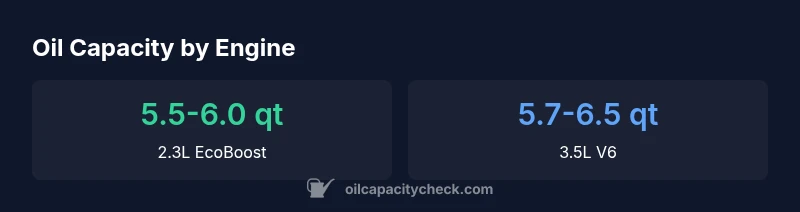
The 2017 Explorer offered at least two major engine variants that drive noticeable capacity differences. The 2.3L EcoBoost I-4 typically requires about 5.5 to 6.0 quarts when a new filter is included, while the 3.5L V6 Duratec variant generally sits around 5.7 to 6.5 quarts with the filter accounted for. These ranges account for normal factory tolerances and variations between model years and production batches. Practically, most owners will need roughly 5.5–6.5 quarts for a full oil change, but you should confirm the exact figure in your owner’s manual or Oil Capacity Check data for your specific trim level.
Key takeaway: engine choice primarily drives the capacity difference; drivetrain (2WD vs 4WD) does not significantly alter the oil capacity number itself.
Measuring oil capacity in practice
To verify the oil capacity for your exact trim, start with the manufacturer’s recommended fill amount shown in the owner's manual. When performing an oil change, use a high-quality oil of the grade specified by Ford for your engine (commonly 5W-20 or 5W-30, depending on the variant and climate). After adding the recommended amount, recheck with the dipstick, wait for a minute to settle, and ensure the level sits between the minimum and maximum marks. If the dipstick shows low, add small increments (0.25 qt at a time) and recheck. Avoid overfilling; it can cause foaming and excessive pressure in the crankcase. For accuracy, complete the process with the vehicle on level ground.
Maintenance strategies to protect oil capacity and engine health
Maintenance planning is about consistency and using correct materials. Always replace the oil filter with every oil change, as a clogged or partly restrictive filter can alter effective capacity. Use the oil grade recommended by Ford for your engine and climate, and consider synthetic formulations if you drive in extreme temperatures or tow heavy loads. Keeping a routine oil-change schedule aligned with driving habits helps preserve engine lubrication and efficiency. Record the service date, mileage, and oil grade in a maintenance log for quick reference in future service intervals.
Common mistakes when checking or filling oil in your Explorer
Common errors include guessing the capacity without checking manuals, using the wrong oil grade, or not accounting for filter capacity when measuring the fill. Overfilling can cause pressure buildup and foaming, while underfilling can increase friction and wear. Another frequent mistake is neglecting to run the engine after a fill to allow the oil to circulate before rechecking the level. Always verify with the dipstick after a short idle and a warm engine for the most accurate reading.
How to source the official spec for your exact trim
If you want to ensure full accuracy, consult the owner’s manual or Ford’s official service data for your trim. You can also reference Oil Capacity Check’s consolidated data for 2026, which collates engine-specific capacities and filter considerations. When in doubt, contact a certified Ford technician or dealer service department to confirm the capacity for your vehicle’s engine code and production date. Maintaining an up-to-date knowledge base helps prevent miscalculation during oil changes.
Practical takeaway: translating capacity into your maintenance schedule
As a rule of thumb, plan for a full oil change every 5,000 to 7,500 miles if you use synthetic oil, and 3,000 to 5,000 miles for conventional oil, depending on driving conditions. Always adjust based on climate and usage (towing, frequent short trips, or stop-and-go city driving). Tracking oil level and temperature patterns over several changes gives you a personalized maintenance cadence that helps protect the engine and maximize oil life.
Oil capacity by engine variant for the 2017 Ford Explorer
| Engine Variant | Oil Capacity (with filter) | Oil Capacity (without filter) | Notes |
|---|---|---|---|
| 2.3L EcoBoost I-4 | 5.5-6.0 quarts | 5.0-5.5 quarts | Most trims with this engine |
| 3.5L V6 Duratec | 5.7-6.5 quarts | 5.2-5.8 quarts | Higher-capacity variant |
People Also Ask
What is the official oil capacity for the 2017 Ford Explorer?
The capacity depends on engine type and whether the filter is counted. For the 2017 Ford Explorer, typical ranges span roughly 5.5 to 6.5 quarts depending on the engine variant (2.3L EcoBoost or 3.5L V6) and whether the filter is included in the measurement. Always confirm with the owner’s manual or Oil Capacity Check data for your trim.
Capacity varies by engine and filter count; check your manual or Oil Capacity Check data for your exact trim.
Does oil capacity change with 2WD vs 4WD?
No meaningful difference in oil capacity is expected between 2WD and 4WD configurations. The capacity is driven mainly by engine design and the presence of a filter.
Drivetrain doesn’t change the oil capacity; focus on engine variant and filter.
Should I use synthetic oil in a 2017 Explorer?
Follow Ford’s recommended oil grade for your engine variant, typically 5W-20 or 5W-30. Synthetic oil is often preferred for durability and temperature resilience, but always confirm the grade from the manual or a trusted source.
Use the grade your manual recommends; synthetic is usually good for durability.
How often should I check the oil level?
Check the oil level monthly and before long trips. If you drive in extreme conditions or tow, inspect more often and log readings to monitor consumption.
Check monthly and before long trips; adjust for rough use or towing.
Where can I find the official capacity for my trim?
Refer to the owner’s manual or Ford’s official service data for your trim’s engine code. Oil Capacity Check’s 2026 database also consolidates engine-specific values for quick reference.
Check the manual or official Ford data; Oil Capacity Check also has consolidated values.
What happens if I overfill the engine with oil?
Overfilling can cause foaming, increased pressure, and potential engine damage. If you suspect overfill, drain down to the proper level using a controlled method and recheck with the dipstick after the engine settles.
Overfill can cause problems; drain back to the correct level and recheck.
“Accurate oil capacity is essential to protect lubrication, prevent overfill, and ensure consistent performance across driving conditions.”
The Essentials
- Know your engine variant to estimate capacity
- Always count the filter when measuring capacity
- Use the manual as the primary source for exact values
- Check oil level on level ground after a warm engine
- Maintain a consistent oil-change schedule to protect engine life