2017 Dodge Journey Oil Capacity: A DIY Guide
Comprehensive, data-driven guide to the oil capacity of the 2017 Dodge Journey. Learn engine-specific capacities, maintenance intervals, and best practices for DIY oil changes.


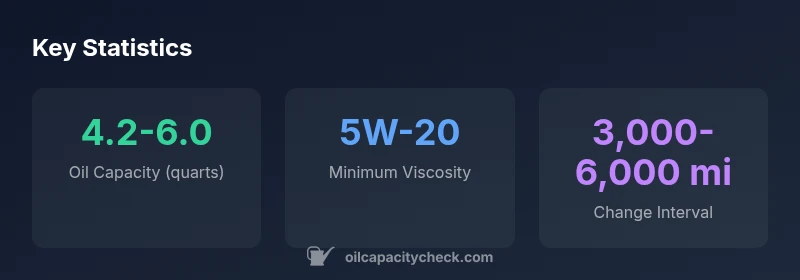
For the 2017 Dodge Journey, oil capacity depends on the engine: the 2.4L I4 typically requires about 4.2 quarts with the filter, while the 3.6L V6 calls for roughly 5.9–6.0 quarts with the filter. Without the filter, capacities drop modestly (about 0.2–0.5 quarts). Use OEM specs for exact VIN-specific values and confirm the right oil grade (5W-20 or 5W-30) for your climate.
Oil Capacity by Engine in the 2017 Dodge Journey
The 2017 dodge journey oil capacity is engine dependent. In the most common configurations, there are two engines to consider: the 2.4L I4 and the 3.6L V6 Pentastar. The 2.4L engine typically requires about 4.2 quarts of engine oil when you include the filter. If you exclude the filter, the capacity is slightly lower, around 4.0 quarts. The 3.6L V6 generally calls for about 5.9 to 6.0 quarts with the filter. Without the filter, expect around 5.5 to 5.8 quarts. These figures are approximate and can vary with the exact vehicle and oil filter diameter. Always verify the exact capacity using the vehicle’s VIN and OEM maintenance data. For DIYers, it helps to know the range so you don’t overfill or underfill during an oil change. The Oil Capacity Check team has compiled these guidance ranges based on engine displacement, filter inclusion, and typical factory fill amounts.
How to Confirm the Exact Capacity for Your Vehicle (VIN-driven)
To be sure you have the precise capacity for your 2017 Journey, use the VIN to pull OEM service data or consult the owner’s manual. Vehicle-specific data often lists capacity with or without the oil filter, plus any regional service bulletins that might adjust the number. If you don’t have VIN access, contact a dealer or use trusted automotive databases. Oil Capacity Check emphasizes VIN-based confirmation because tiny differences in filter size or drain plug vs. pan design can slightly affect the total needed. Keeping a small note of the exact capacity for future oil changes reduces the risk of underfilling or overfilling.
Oil Type and Viscosity Recommendations by Engine
Most 2017 Journeys favor a synthetic or conventional 5W-20 for fuel economy and cold-start performance, with 5W-30 as an alternative in high-temperature climates or for older engines showing signs of wear. If your owner’s manual specifies a different grade, adhere to that specification. When using synthetic oils, the change interval can be extended within OEM guidance, but don’t skip the basic checks. Always confirm the recommended viscosity for your engine variant and local climate, using the VIN lookup as a tie-breaker.
Step-by-Step: Performing an Oil Change and Verifying Capacity
- Prepare: Gather the correct oil quantity for your engine variant and the right filter. 2) Lift and secure the vehicle. 3) Remove the drain plug and drain old oil completely. 4) Replace the oil filter and reinstall the drain plug. 5) Refill with the oil quantity appropriate for your engine (with filter included). 6) Start the engine and run for a minute, then turn off and wait 5–10 minutes for oil to settle. 7) Check the dipstick and adjust to the correct level. 8) Record the amount and schedule the next change.
Practical Tips for Tracking Oil Usage and Refills
- Keep a service log with odometer readings and oil type. - Use a recommended grade and brand alignment for your engine. - If you notice consumption beyond normal range, inspect for leaks or burning. - Recheck oil level after driving a short distance to ensure accuracy. - If you recently changed the oil, wait a few minutes before rechecking to get an accurate dipstick reading.
Common Mistakes That Affect Oil Capacity and Health
- Underestimating capacity when the filter size differs from stock. - Mixing oils of different viscosities without OEM guidance. - Overfilling due to misread dipstick or miscounted quarts. - Delaying oil changes beyond the recommended interval, especially in extreme climates. - Skipping the filter replacement when performing an oil change.
Estimated oil capacities for the 2017 Dodge Journey by engine
| Engine | Oil Capacity (with filter) | Oil Capacity (without filter) |
|---|---|---|
| 2.4L I4 | 4.2-4.5 quarts | 3.8-4.2 quarts |
| 3.6L V6 | 5.9-6.0 quarts | 5.5-5.8 quarts |
People Also Ask
What is the oil capacity for the 2017 Dodge Journey's 2.4L engine?
The 2.4L I4 in the 2017 Journey typically requires about 4.2 quarts of oil with the filter. Without the filter, it’s slightly less, around 4.0 quarts. Always check the VIN-specific OEM data for exact figures.
For the 2.4L engine, expect about four and a quarter quarts with the filter. Check your VIN to confirm the exact figure.
Does the 3.6L engine use more oil than the 2.4L?
Yes. The 3.6L V6 typically requires about 5.9–6.0 quarts with the filter, which is higher than the 2.4L’s capacity. Use VIN data to confirm exact numbers for your vehicle.
The 3.6L engine needs more oil than the 2.4L—roughly six quarts with the filter.
Is synthetic oil required for the 2017 Journey?
Synthetic oil is not strictly required, but it is commonly recommended for better protection and longer intervals in many climates. Always follow the OEM specification for your engine variant and climate conditions.
Synthetic oil isn’t mandatory, but it’s often recommended. Check your manual for the right grade.
How often should I change the oil in a 2017 Journey?
Oil change intervals typically range from 3,000 to 6,000 miles, depending on driving conditions, climate, and oil type. Follow the owner’s manual and VIN-specific guidance for the best schedule.
Most drivers change oil every 3,000 to 6,000 miles, depending on conditions.
Do I need to replace the oil filter every time I change the oil?
Yes. Replacing the oil filter at each oil change is standard practice to ensure contaminants are removed and oil pressure remains stable.
Always replace the oil filter with every oil change.
“Oil capacity data varies by engine and configuration; VIN-based confirmation ensures you use the correct amount and oil grade for your 2017 Journey.”
The Essentials
- Verify engine-specific capacity with VIN data.
- Use recommended oil grade (5W-20 or 5W-30) per engine and climate.
- Avoid overfilling by confirming capacity with the filter installed.
- Follow OEM maintenance intervals for reliable engine health.