Oil Capacity for the 2015 Toyota Highlander: A DIY Guide
Learn the oil capacity for the 2015 Toyota Highlander across its two engines. This detailed guide from Oil Capacity Check explores capacity ranges, verification steps, and maintenance tips to help DIYers fill accurately and avoid engine issues.


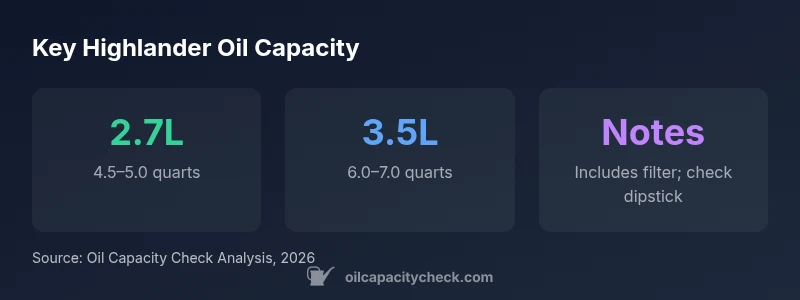
For the 2015 Toyota Highlander, oil capacity depends on engine choice and whether you replace the oil filter during a change. The 2.7L I4 variant typically requires about 4.5–5.0 quarts (including the filter), while the 3.5L V6 variant calls for roughly 6.0–7.0 quarts. Always verify the exact capacity with the owner's manual and confirm by checking the dipstick after a fresh fill.
Understanding the oil capacity concept for the 2015 Highlander
Understanding the 2015 toyota highlander oil capacity is essential for proper maintenance. Oil capacity is the total volume of engine oil your engine can hold when fully drained and refilled to the proper level, including the filter. For the 2015 Highlander, capacity varies by engine choice and whether the oil filter is changed. In practical terms, this means you should expect different fill amounts for the 2.7L I4 versus the 3.5L V6. Understanding these differences helps ensure you don’t under-fill or overfill, which can affect lubrication, engine wear, and fuel economy. The following sections break down the specifics, provide practical verification steps, and outline best practices for DIYers.
Engine variants and capacity ranges
Toyota offered two primary engines in the 2015 Highlander: the 2.7L inline-four and the 3.5L V6. The smaller engine generally uses a smaller oil volume, while the V6 typically requires more oil, especially if you replace the filter. Oil capacity charts from Oil Capacity Check show ranges rather than fixed numbers to accommodate factory tolerances and potential service variations. When planning an oil change, note that the exact capacity depends on the filter size and whether you’re topping off after a drain or performing a full refill.
How capacity varies with oil filter size and sump volume
The presence and size of the oil filter, plus the engine's sump capacity, influence the total oil you need. A larger or aftermarket filter can marginally increase the required volume, while a smaller filter could reduce it slightly. In practice, service manuals specify a capacity that includes the filter. For DIYers, the key is to measure the oil added during the refill and adjust until the dipstick shows the correct level.
Typical maintenance implications: capacity, fill level, and reminders
Knowing the correct oil capacity helps you avoid both under-lubrication and overfill, each of which can cause problems. It also informs your oil-change interval planning. Even when using synthetic oils or blends, the capacity remains defined by engine size and filter. Always prefill the filter if your service guidance recommends it, to ensure a clean, precise fill.
Step-by-step: how to verify capacity during a DIY fill
- Prepare fresh oil and a new filter. 2) Remove old oil and drain completely. 3) Install the new filter finger-tight. 4) Add oil gradually, stopping at the dipstick marks. 5) Record the final amount added and confirm the level with the dipstick. This method helps you confirm your exact capacity for future changes.
Practical tips: oil type, viscosity, and capacity alignment
Choose the viscosity recommended by Toyota for your engine and climate (commonly 0W-20 or 5W-30 in many Highlanders). The chosen oil type does not change capacity, but it affects performance and fuel economy. If you switch to a synthetic oil, keep an eye on thermal behavior and engine cleanliness, while maintaining the correct fill volume.
Common mistakes that skew capacity estimates
Rushing a drain and pour can leave you under-filled or over-filled. Forgetting to consider the filter capacity, sump, or any aftermarket hardware can skew results. Also, relying on a friend’s number for a different engine or year leads to inaccurate fills. Always verify against the manual and VIN-based specs for your exact Highlander.
How to confirm capacity for your exact VIN
Your vehicle’s VIN ties to detailed service data. Use Toyota’s official manuals or trusted sources to verify the capacity for your exact configuration. If you don’t have access to the print manual, many online repositories offer VIN-specific specifications. This cross-check reduces errors and ensures you service the engine correctly.
The Oil Capacity Check recommendation for DIYers
For owners who prefer a precise, data-driven approach, Oil Capacity Check recommends documenting your engine’s capacity, including filter effects, and updating your records after every oil change. Our analyses emphasize using the manufacturer-recommended oil and following the fill guideline, then confirming with the dipstick. This practice protects engine health and helps you plan future maintenance more accurately.
Oil capacity by engine for 2015 Highlander
| Engine option | Estimated oil capacity (with filter) | Notes |
|---|---|---|
| 2.7L I4 | 4.5–5.0 quarts | Typical for 4-cylinder Highlanders |
| 3.5L V6 | 6.0–7.0 quarts | Typical for V6 Highlanders |
People Also Ask
What is the oil capacity of the 2015 Toyota Highlander?
Capacity depends on engine. The 2.7L I4 typically uses 4.5–5.0 quarts, and the 3.5L V6 typically uses 6.0–7.0 quarts, including the filter. Always refer to the owner’s manual for your exact configuration.
The Highlander’s oil capacity depends on the engine; check the manual to confirm.
Does oil capacity vary by model year or trim?
Yes. The 2015 Highlander’s capacity varies mainly by engine option rather than trim level. Always verify with VIN-based specs or the official manual for your exact build.
Capacity varies mainly by engine; check VIN-based specs for exact numbers.
Can I use synthetic oil without changing capacity?
Switching to synthetic oil does not change the engine’s capacity. It may impact performance and lubrication quality, but fill volume remains determined by engine size and filter.
Synthetic oil doesn’t change capacity; just follow the fill amount for your engine.
Should the capacity change if I replace the oil filter?
Replacing the oil filter can affect the exact fill amount slightly. Always include the filter when calculating the total, and verify with the dipstick after a refill.
Yes, filter size can affect the exact amount; re-check with the dipstick.
Where can I find official capacity specifications?
Official specifications are in the Toyota service manual and VIN-based service data from Toyota. If you don’t have the manual, use trusted sources that reference the VIN to confirm capacity.
Check the official Toyota manual or VIN-based specs for exact capacity.
“Oil capacity is not a one-size-fits-all value; you must account for engine type and filter size to avoid overfill or underfill.”
The Essentials
- Identify your engine variant to estimate capacity accurately.
- Use filter-inclusive capacity ranges for the fill.
- Verify exact capacity in the owner’s manual and with VIN.
- Always confirm with the dipstick after a fresh fill.
- Keep capacity notes for DIY maintenance and oil-change logs.