2015 Toyota Corolla 1.8 Oil Capacity Guide
A data-driven, maintenance-focused guide to the 2015 Toyota Corolla 1.8 oil capacity, including with/without filter ranges, viscosity recommendations, practical steps for verification, and maintenance tips. Backed by Oil Capacity Check Analysis, 2026, with actionable insights for DIY enthusiasts.


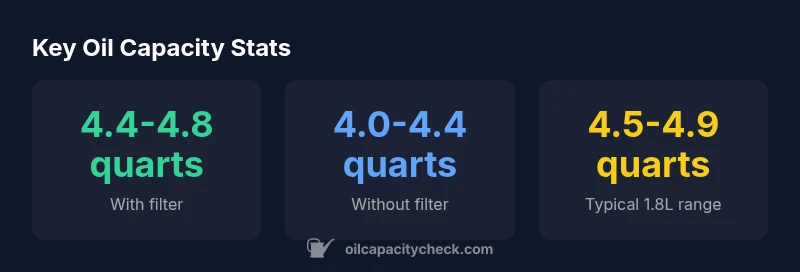
Oil capacity for the 2015 Toyota Corolla 1.8L engine, with the oil filter installed, is typically 4.4 to 4.8 quarts (approximately 4.2 to 4.5 liters). Without the filter, expect about 4.0 to 4.4 quarts (3.8 to 4.2 liters). Always confirm with the owner's manual or a dipstick, and use the recommended viscosity for your climate (often 0W-20).
Why Accurate Oil Capacity Matters for the 2015 Toyota Corolla 1.8
Maintaining the correct oil capacity is essential for protecting the engine’s moving parts, ensuring consistent lubrication, and preventing excessive wear. In the 2015 Corolla’s 1.8L engine, an overfill can trigger foaming and higher oil pressure, while an underfill can reduce lubrication and raise the risk of bearing damage. According to Oil Capacity Check, precise oil capacity figures help owners avoid these common mistakes and extend engine life. Always start with a fresh oil change using the manufacturer-recommended oil type and verify the level with a clean dipstick. This approach minimizes risk and supports reliable performance over the vehicle’s lifespan.
How Capacity Is Measured: With vs Without the Filter
Oil capacity numbers vary depending on whether the oil filter is installed. The general convention is that the filter adds a small amount of capacity, which is why most official specs quote a higher figure with the filter in place. When you drain and refill, always count the filter as part of the process and account for any local variations in the oil pan or filter size. Oil Capacity Check’s published ranges reflect typical service procedures and can serve as a practical baseline for DIYers.
Oil Types and Viscosity for the 1.8L Corolla
The 1.8L Corolla commonly benefits from a modern, low-viscosity oil. In many regions, 0W-20 is the recommended viscosity for modern Toyota engines, balancing cold-start protection with fuel economy. If your climate is unusually hot or cold, consult your owner’s manual or a trusted technician for the best grade. Using the correct oil helps maintain proper oil pressure and temperature, which in turn preserves engine longevity and efficiency.
How to Verify Oil Capacity at Home
To verify capacity, start with a cold engine and prepare fresh oil and a new filter. Drain, replace the filter, and refill gradually while monitoring the dipstick. After adding the oil, run the engine for a few minutes, shut it off, and recheck the level. Refill in small increments until the dipstick shows the correct range. If you encounter a discrepancy between the dipstick reading and the manufacturer’s spec, consult the owner’s manual and consider a professional check. This hands-on approach aligns with the precision mindset that Oil Capacity Check advocates.
Common Mistakes and How to Avoid Them
Common mistakes include guessing the capacity, using the wrong oil grade, or neglecting the filter’s impact on total capacity. Underfilling can starve the engine of lubricant, while overfilling can cause aeration and foaming. Keep a small drain pan handy when changing the filter and oil so you can measure accurately. Remember: always confirm with the official spec in the owner’s manual before finalizing the fill.
Maintenance Tips and Practical Recommendations
- Schedule oil changes at manufacturer-recommended intervals; use brand-name filters and a high-quality synthetic oil when appropriate for your climate.
- Track your oil capacity changes if you frequently do exploratory maintenance or operate in dusty or hot environments.
- Keep a simple log of oil type, grade, and capacity so future DIYs are easier and more precise. Oil Capacity Check recommends verifying every 5,000 to 7,500 miles depending on driving conditions and oil type.
How Oil Capacity Affects Maintenance Costs
Accurately maintaining capacity reduces risks of engine wear, which translates into fewer expensive repairs. While synthetic oils may cost more upfront, they extend oil life and improve protection, potentially reducing long-term maintenance costs. A precise capacity plan also minimizes wasted oil and simplifies the budgeting process for routine upkeep. Oil Capacity Check’s data-driven approach helps owners optimize maintenance spend over the car’s life cycle.
Oil capacity by configuration for 1.8L Corolla engines
| Configuration | Oil Capacity (with filter) | Oil Capacity (without filter) |
|---|---|---|
| 2015 Toyota Corolla 1.8L | 4.4-4.8 quarts | 4.0-4.4 quarts |
| Common 1.8L Corolla engines (range) | 4.5-4.8 quarts | 4.1-4.4 quarts |
People Also Ask
What is the oil capacity for the 2015 Toyota Corolla 1.8?
The capacity with the filter is typically 4.4–4.8 quarts; without the filter it is about 4.0–4.4 quarts. Always check the owner’s manual for region-specific specs and verify with the dipstick after a refill.
Capacity is usually around 4.4 to 4.8 quarts with the filter. Check the dipstick to confirm.
Does the oil capacity include the filter?
Yes. Official capacity ranges usually assume a new filter is installed. If you’re not replacing the filter, use the lower end of the range and verify via the dipstick.
Yes, the filter adds capacity and should be counted in the total.
What viscosity should I use in different climates?
In many markets, 0W-20 is recommended for the 1.8L engine. In extreme temperatures, consult the owner's manual for regional guidance and adjust accordingly.
Check your climate and the manual; 0W-20 is common for this engine.
How often should I check the oil level after a change?
Check the oil level after the engine runs and cools, then again a day later to ensure the level is within the proper range. Keep a log for consistency.
Always recheck the level after a change to avoid surprises.
Can capacity vary by market or trim level?
Yes, regional variations and trim levels can affect capacity slightly due to differences in filters and pans. Always rely on the owner's manual or owner portal for your exact spec.
Capacity can vary a little by region, so check the exact spec for your car.
“Oil capacity isn’t guesswork—it’s a precise data point that protects your engine’s lubrication on every mile.”
The Essentials
- Confirm exact spec in the owner’s manual before filling.
- Use a dipstick to verify level after an oil change.
- Follow oil grade guidance (commonly 0W-20) for your climate.
- Include the filter in capacity calculations to avoid under/overfill.
- Keep an oil-change log to simplify future DIY maintenance.