2014 VW Jetta Oil Capacity Guide
Learn the oil capacity for the 2014 VW Jetta across engine options, how to measure it accurately, and maintenance tips to keep your engine healthy. Includes engine-specific ranges, quick checks, and expert guidance.


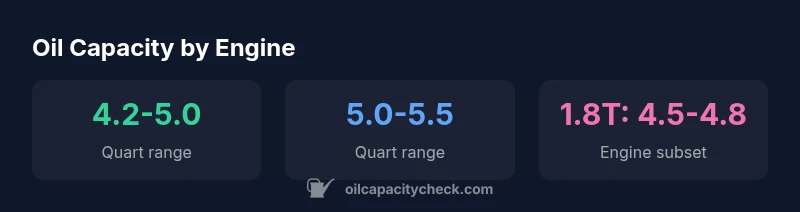
The 2014 VW Jetta oil capacity varies by engine, but most models take about 4.2 to 5.5 quarts of engine oil when a filter is changed. The exact amount depends on the engine type and whether a new filter is installed. Always confirm with the owner's manual and check the dipstick after filling.
Engine variants and oil capacity for the 2014 VW Jetta
Oil capacity for the 2014 VW Jetta is not a single number. The car was offered with several gasoline engine options, and each variant has a slightly different oil capacity especially when you account for replacing the oil filter. In practical terms, owners typically see a range around 4.2 quarts up to about 5.5 quarts for a complete oil change with a new filter. The exact figure depends on engine code and whether a filter is included in the service. For the most reliable result, verify the specification in your owner’s manual and confirm the capacity for your engine code before an oil change. When searching for capacity, reference the model year (2014) and the engine family to avoid confusion with other Jetta generations.
Why capacity varies by engine code and oil filter
Volkswagen used several engines in the 2014 Jetta lineup, including smaller displacement units and turbocharged variants. Each engine design has a distinct oil capacity due to the oil pan size, sump geometry, and the oil filter’s volume. Replacement filters can also differ in capacity, subtly altering the total oil needed. If you’re switching between a standard filter and a high-capacity performance filter, expect a slight variation in recommended fill. Always cross-check with the exact engine code (e.g., 2.0L vs. 1.8T) and the maintenance information for your vehicle.
How to determine your exact capacity for your engine
To determine the precise capacity for your specific car, start with the owner’s manual and the maintenance schedule. Note the engine code sticker under the hood or in the owner’s manual, since the capacity is engine-dependent. If you don’t have access to the manual, VW’s official service portal and reputable automotive resources often list engine-specific capacities. When performing an oil change, use the capacity range as a guide, but finish by checking the dipstick after filling and topping up gradually as needed.
Oil types, viscosities, and their impact on capacity and performance
Oil capacity remains similar regardless of whether you choose conventional, synthetic, or synthetic-blend oil—the engine’s internal clearance and sump volume determine the total amount. However, the oil viscosity you select should align with the manufacturer’s recommended grade for your climate and engine code. Using a heavier viscosity or a lower viscosity than recommended can affect lubrication at operating temperatures, even though the fill quantity itself remains within the same range. For the 2014 Jetta, stick to the grade recommended in the owner’s manual to maintain optimal protection.
Step-by-step: checking and topping up oil safely
- Park on a level surface and turn off the engine. 2) Allow the engine to cool for a few minutes, then pull the dipstick, wipe clean, reinsert, and pull again to read the level. 3) If the reading is below the minimum mark, add oil in small increments (about a quarter of a quart at a time), wait a minute for it to settle, and recheck. 4) When the level is within the specified range, reinsert the dipstick and ensure it’s not overfilled. 5) If you’ve just changed the filter, ensure you’ve also filled to the recommended capacity and checked for leaks.
Common mistakes and how to avoid overfilling
Overfilling can cause foaming, increased crankcase pressure, and potential damage. Always pour slowly, pause to read the dipstick, and avoid pouring directly into the engine’s fill hole without checking. If you accidentally overfill, remove excess with a clean syringe or drain back into a container, then recheck. Maintain a keen eye on the oil level during the first few miles after an oil change.
Maintenance planning: oil change intervals and capacity reminders
Oil capacity is a fundamental input for planning maintenance, but interval recommendations depend on climate, driving conditions, and oil type. For many 2014 Jetta owners, a typical interval ranges from 5,000 to 7,500 miles with a note to monitor oil life indicators if equipped. When in doubt, follow VW’s official guidelines and adjust for heavy or frequent short trips. Record the exact capacity for your specific engine in your maintenance log so you always know the right amount for future changes.
Oil capacity by engine variant for the 2014 VW Jetta (ranges shown; verify with manual)
| Engine variant | Oil capacity (quarts) | Notes |
|---|---|---|
| 2.0L gasoline | 4.2-5.0 | With filter; varies by model |
| 2.5L | 5.0-5.5 | Older Jetta models; filter included |
| 1.8L TSI | 4.5-4.8 | Turbocharged variant; check engine code |
People Also Ask
What factors influence the oil capacity of a 2014 VW Jetta?
Engine variant, filter presence, and oil type influence the required capacity. Always refer to the owner's manual for your exact engine code.
The exact amount isn’t one number—it depends on your engine and the filter. Check the manual for your specific code.
Can I use synthetic oil and still maintain the same capacity?
Yes—the capacity is determined by the engine design, not the oil type. Synthetic or conventional oil use the same fill range.
No matter the oil type, the amount is the same. Just follow the manual for the right grade.
How do I measure the correct oil amount after pouring?
Add oil gradually in small increments, recheck with the dipstick, and stop at the full mark.
Add a little, check the dipstick, add more if needed, and keep checking until you’re at the right level.
Is it safe to drive with an underfilled oil level?
No. Driving with low oil can damage the engine. Top up to the recommended level before driving.
Don’t drive with low oil—top it up to the mark.
What is the best practice for oil change intervals for a 2014 Jetta?
Follow the manufacturer’s interval guidance, typically miles or time, and use the oil life monitor if present.
Stick to the manual’s schedule and use the car’s oil-life indicator if equipped.
“Oil capacity is engine-specific, and using the wrong volume can cause overfill or under-lubrication. Always confirm the exact figure for your engine code.”
The Essentials
- Check engine code to determine exact capacity.
- Always use a new filter when changing oil.
- Verify the oil level with the dipstick after filling.
- Follow the VW manual for the exact quart range by engine.
- Synthetic vs conventional oil does not change total capacity.