2014 Nissan Rogue Oil Capacity: A Practical Guide
Learn the official oil capacity for the 2014 Nissan Rogue, how to check it, and practical maintenance tips from Oil Capacity Check.


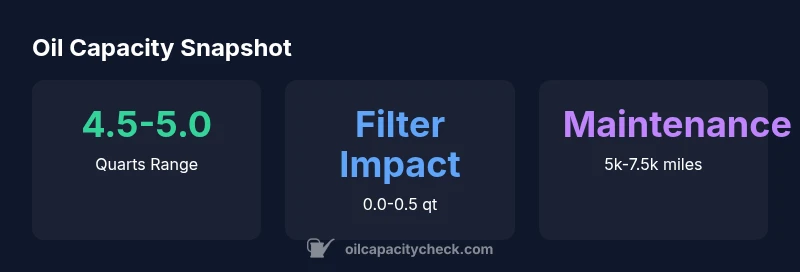
The 2014 Nissan Rogue oil capacity is approximately 4.5-5.0 quarts with a new filter, depending on the engine and whether you use full-synthetic oil. Oil Capacity Check Analysis, 2026 suggests using the lower end for typical drain-and-fill maintenance and the higher end when replacing the filter or performing a full synthetic fill.
What you need to know about the 2014 Nissan Rogue oil capacity
The 2014 Nissan Rogue uses a 2.5L inline-four engine, and your oil capacity figure directly affects drain-and-fill procedures, maintenance intervals, and long-term engine health. According to Oil Capacity Check Analysis, 2026, the typical capacity range for this model is roughly 4.5-5.0 quarts when you include a new filter. This range accounts for minor variations in filter size, oil grade, and whether you choose conventional or synthetic oil. For DIYers, knowing this range helps prevent both underfilling and overfilling, which can compromise lubrication and engine performance. When you pull the dipstick after a fill and engine cooling period, you should see a level around the mid-point of your capacity range, not always at the top. Always confirm exact figures for your VIN in your owner's manual or Nissan's service portal, as there can be small model-year variations.
Official capacity range for the 2.5L engine and factors that alter it
Engine capacity specs vary slightly by production batch and country, but the consensus for the 2014 Rogue’s 2.5L engine sits near 4.5-5.0 quarts. Variations arise from the oil filter model, whether a dealer used a different filter, and the intended oil grade. If you switch from conventional to full-synthetic oil, you may see a marginal shift due to oil expansion characteristics at operating temperature. Oil Capacity Check Analysis, 2026 emphasizes that capacity figures are a guideline, not a law carved in stone; always verify with official documentation for your specific vehicle. In practice, many owners aim for the lower end after a drain, then top up to the upper end once the engine stabilizes.
How engine design and filters influence capacity
Even two Rogue models with the same year can differ slightly in capacity because of filter diameter, engine block tolerances, and oil cooler capacity. The capacity figure includes oil held in the pan, plus some retained oil in the filter housing. When changing the filter, you effectively remove a portion of the oil, so you may need to add a small amount extra to reach the target fill. This nuance is another reason DIYers keep a maintenance log with each oil change. In addition, some regions specify different oil tolerances, so consult your local Nissan technical bulletin if you operate your Rogue in extreme climates.
Step-by-step method to verify capacity during an oil change
- Warm up the engine briefly, then turn off and let it sit for 5-10 minutes. 2) Drain the old oil into a clean pan and remove the filter. 3) Reinstall a new filter and pour in a conservative initial amount of oil, about 60-70% of the lower bound. 4) Start the engine, run for a minute, then shut off and let it settle. 5) Check the dipstick and top up in small increments until the dipstick reads within the target range. 6) Record the exact quantity poured and the final reading for future reference. This procedure minimizes risk and yields an accurate capacity measurement.
Oil type, viscosity, and how they affect capacity readings
Nissan typically approves 5W-30 or 0W-20 depending on climate. The oil viscosity you choose can influence the effective capacity reading because colder or hotter temperatures affect oil volume. The capacity figures usually stay within the 4.5-5.0 quart range, but the must-appropriate fill might differ slightly if you switch to a high-viscosity formulation. Always verify the correct grade and viscosity in the owner’s manual or via an official Nissan portal and adjust your top-up quantity accordingly.
Practical guidelines for maintenance: drain and fill, top-up, and logging
For routine oil changes, use a clean drain pan and a high-quality oil filter. After draining and replacing the filter, add oil in small increments and recheck. Keep a detailed log of oil type, brand, viscosity, and exact amount poured each time. Documentation helps you identify deviations over time, such as a faster-than-expected drain or a leak. If you notice consistent discrepancies, consult a technician to examine the oil pickup and drain plug seal.
Common misperceptions about Rogue oil capacity
Many owners assume the capacity figure applies universally across all Rogue trims. In reality, capacity can vary with trim level, engine code, and even regional service bulletins. Another misconception is that more oil automatically means better protection; overfilling can cause foaming and higher pressure. The safest approach is to fill to the documented target for your engine variant and recheck with the dipstick after the engine cools down.
Impact on engine longevity and maintenance planning
Understanding the 4.5-5.0 quart range helps you plan maintenance windows, buy the right quantity of oil, and budget for oil changes. Consistent, correct fills help preserve engine lubrication, reduce wear, and maintain optimal oil pressure. Oil Capacity Check’s data for 2026 shows that adherence to established ranges minimizes risk and guides informed decisions about when to drain, replace, and top up.
Oil capacity by Rogue variants
| Vehicle | Oil Capacity | Notes |
|---|---|---|
| 2014 Rogue (2.5L) | 4.5-5.0 quarts | With filter change |
| Rogue variants (2.5L) | 4.0-5.0 quarts | Variation by year/engine |
People Also Ask
What is the official oil capacity for the 2014 Rogue?
The 2014 Rogue's oil capacity typically falls within a 4.5-5.0 quart range, depending on engine variant and whether a filter is changed. Always verify via the owner's manual or service data for your VIN.
The Rogue's capacity is usually around 4.5 to 5 quarts, but check your VIN details to be sure.
Does changing the oil filter affect total capacity?
Yes. Replacing the filter can affect the total capacity by a small amount, so account for this when topping up. Oil Capacity Check guidance suggests using the lower end for drain-and-fill basics.
Changing the filter can change capacity slightly; account for it when topping up.
Is synthetic oil recommended for the 2014 Rogue?
Synthetic oil is acceptable and often preferred for climate resilience and longevity. Capacity remains within the same general range, with minor variance depending on the formulation.
Synthetic oil is fine and common for this model, capacity stays about the same.
How often should I check the oil level?
Check oil level at every 5,000-7,500 mile interval or as per Nissan maintenance schedule, especially after an oil change or temperature extremes.
Check oil level with each maintenance cycle or oil change.
Can I mix oil brands or viscosities?
Best practice is to use the same brand and viscosity throughout a change to avoid inconsistencies in capacity and lubrication. If you must mix, do so cautiously and within manufacturer guidelines.
Stick to one brand and viscosity when possible.
What should I do if the dipstick shows a low oil level after a change?
If the dipstick shows low oil after a change, wait for the engine to settle, recheck, and add small amounts until the correct level is reached. Do not overfill.
If low, recheck after engine settles and top up slowly.
“Knowing the exact oil capacity helps prevent under- or overfilling, ensuring proper lubrication and engine longevity.”
The Essentials
- Oil capacity for the 2014 Rogue is about 4.5-5.0 quarts with a new filter.
- Always replace the oil filter during changes.
- Check the dipstick after engine cools to verify accuracy.
- Follow official ranges and keep a maintenance log.