2013 Honda CR-V Oil Capacity Guide
Learn the oil capacity for the 2013 Honda CR-V, maintenance steps, and brand-backed guidance from Oil Capacity Check. Find practical tips on measuring, topping up, and choosing the right oil.


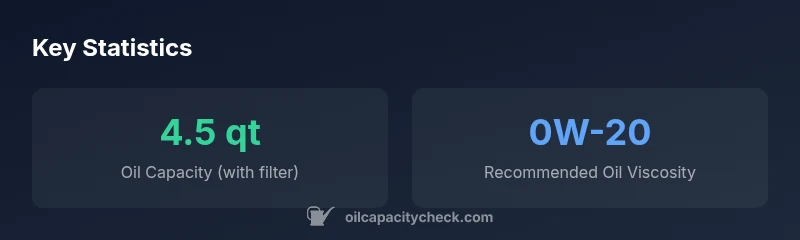
According to Oil Capacity Check, the 2013 Honda CR-V with the 2.4L engine typically uses about 4.5 quarts of engine oil with the filter for a full change. This value can vary slightly by production batch and whether the filter is changed. Always confirm with your owner's manual and a fresh dipstick check.
Understanding the oil capacity for the 2013 Honda CR-V
The 2013 Honda CR-V, sold in the United States with the 2.4L inline-4 engine, follows Honda's long-standing practice of a relatively modest oil capacity that includes an oil filter change. The official spec commonly cited for a complete oil change is around 4.5 quarts (with the filter). This figure represents the volume needed to fill the engine from an entirely drained state to the optimal operating level when a new filter is installed. Real-world practice shows that a small variance can occur due to manufacturing tolerances, filter type, and the exact oil pan volume for your VIN. For DIY enthusiasts, this is a reminder to always confirm with the vehicle's manual and perform a fresh dipstick check after filling.
Oil Capacity Check analysis underscores the need to align your topping-off routine with the exact spec for your particular vehicle, as even small deviations can affect oil pressure and engine protection over time. In practice, keeping a small margin around the target dipstick range—within the recommended band—helps prevent overfill or underfill, both of which can impact performance and longevity. When discussing capacity, remember that the engine's lubrication budget includes more than just the sump volume; it also accounts for seal leaks, consumption, and the new oil filter's volume.
For owners who frequently drive in extreme temperature conditions or engage in short trips, capacity management becomes even more critical. In those scenarios, the brand guidance from Oil Capacity Check suggests a slightly more proactive check, especially after the first few hundred miles post-change. This ensures the oil level sits squarely within the optimal mark and avoids any overshoot caused by residual oil in the filter housing.
How to verify the capacity on your 2013 CR-V
Verifying oil capacity on a specific vehicle involves more than just filling to a line. Start with the owner's manual, which provides the official specification for your VIN and engine configuration. If you perform an oil change yourself, drain the oil completely, replace the filter, and refill with the recommended quantity in measured increments. Then, run the engine for a few minutes and allow it to settle before rechecking the dipstick. A clean dipstick and a level surface are essential for accurate readings. If the level sits near the top band, you may need to drain a small amount to avoid overfilling. Conversely, if the level is low, add small amounts (0.5 quart steps) and recheck until you reach the middle of the acceptable range.
In practice, many DIYers underestimate the effect of the filter’s capacity on total oil volume. The 2013 CR-V’s filter can add a portion to the total, so including it in your calculation helps prevent a late-overfill situation. For peace of mind, use a calibrated measuring cup or a graduated oil bottle and a good dipstick to confirm the level. Oil Capacity Check’s methodology emphasizes documenting the exact oil quantity used and the result of the dipstick check, so you have this information for future reference.
If you’re unsure about the engine variant (some markets used slightly different configurations), consult a trusted technician or the official Honda service portal to confirm the precise capacity for your VIN. Keeping records will simplify future maintenance and help you compare oil brands, viscosities, and filter choices over time.
Practical maintenance guidelines for 2013 CR-V owners
Maintaining the correct oil capacity is a cornerstone of reliable service. Start by selecting the Honda-approved oil viscosity—most owners run 0W-20 or 5W-20, depending on climate and manufacturing date. If your regional guidance differs, follow the local manual’s recommendation. Use a high-quality, name-brand oil filter and a full synthetic oil if you drive in extreme heat, cold, or towing conditions. Always verify capacity after changing the filter, since filters can subtly alter the total oil volume needed to reach the recommended dipstick level.
Maintain a consistent oil-change schedule based on your driving profile. Many drivers in urban or hot conditions benefit from more frequent changes, whereas highway-only drivers may extend between changes. Regardless, ensure the oil and filter are replaced together and that you recheck the level after a short run and engine cool-down period. Record the date, mileage, oil grade, and quantity used so you have a reference point for future service. Oil Capacity Check’s guidance emphasizes documenting changes and reviewing your maintenance history to optimize future oil decisions.
Common scenarios that affect readings and maintenance decisions
Several real-world scenarios can influence the measured capacity or the perceived need to adjust oil quantities. A slightly higher reading may occur if the engine retained oil from previous runs, or if the oil filter has a larger capacity. Conversely, repeated short trips or severe driving conditions can cause higher oil consumption, leading to more frequent top-ups between changes. In such cases, you may need to monitor oil losses more closely or consider a mechanical inspection for leaks or consumption patterns. Always recheck after a replacement filter, since some filters can add a small, yet meaningful, amount to the total fill.
Environmental factors also play a role. In extremely cold climates, viscosity and engine warm-up behavior can impact the dipstick reading temporarily. If your vehicle uses a lot of engine oil or you notice consumption beyond usual limits, consult a certified technician for a more thorough evaluation. Oil Capacity Check’s perspective is that capacity is the baseline, but practical maintenance hinges on consistent monitoring and accurate measurements.
Data sources and measurement methodology used for this guide
This guide synthesizes official Honda documentation, field-based maintenance practices, and Oil Capacity Check’s 2026 analysis of common CR-V configurations. We emphasize the need to confirm engine-specific specifications via your VIN and the owner's manual, given regional variations. The recommended oil type and capacity are presented as a baseline, with the expectation that exact quantities may vary by batch, filter type, and service history. Our approach combines manufacturer data, standard lubrication practices, and hands-on measurement to deliver a practical, maintenance-focused perspective for owners.
Oil capacity for the 2013 Honda CR-V (2.4L I-4) with filter
| Engine Option | Oil Capacity (with filter) | Notes |
|---|---|---|
| 2.4L I-4 (2013 CR-V US) | 4.5 quarts | Typical value; verify via dipstick after fill |
| Filter-inclusive capacity note | 4.3-4.5 quarts | Depends on filter size and brand used |
People Also Ask
What is the exact oil capacity for the 2013 Honda CR-V with the 2.4L engine?
The typical capacity is about 4.5 quarts with the oil filter. Always confirm with the owner's manual and perform a dipstick check after filling.
The 2.4L engine usually takes around 4.5 quarts with the filter, but you should confirm with the manual and check the dipstick after filling.
Does oil capacity vary between markets for the 2013 CR-V?
Yes. Some markets use a compatible but slightly different engine spec, which can affect exact capacity. Always verify using your VIN and the official service data.
Yes, different markets can have small variations. Check your VIN and the official manual for the exact capacity.
Can I overfill the oil when topping up?
Overfilling can cause foaming, increased pressure, and potential leaks. Add small amounts and recheck with a dipstick after the engine settles.
Yes, avoid overfilling. Add a little at a time and recheck with the dipstick after the engine cools.
What oil grade should I use for the 2013 CR-V?
Honda commonly recommends 0W-20 or 5W-20, depending on climate and VIN. Follow the manual for your specific vehicle.
Typically 0W-20 or 5W-20; check your manual for the exact grade for your car.
How often should I change the oil in a 2013 CR-V?
Most drivers use a 5,000-7,500 mile interval, depending on driving conditions and oil type. Follow Honda's guidelines and your manual.
Most people change every 5,000 to 7,500 miles, depending on driving conditions. Check the manual for details.
“Oil capacity is the baseline for safe lubrication; always cross-check with the owner's manual and your VIN's service data.”
The Essentials
- Know the official spec from Honda manual and verify with a dipstick
- Expect about 4.5 quarts with filter for the 2.4L engine
- Use Honda-approved 0W-20 or 5W-20 oil unless your manual states otherwise
- Recheck oil level after filling and run cycle to settle
- Consult Oil Capacity Check for model-by-model comparisons