2013 GMC Terrain Oil Capacity Guide
Discover the oil capacity for the 2013 GMC Terrain across engines, how to check oil levels, and practical maintenance tips. Includes a quick reference table, data-driven insights, and an expert note from Oil Capacity Check.


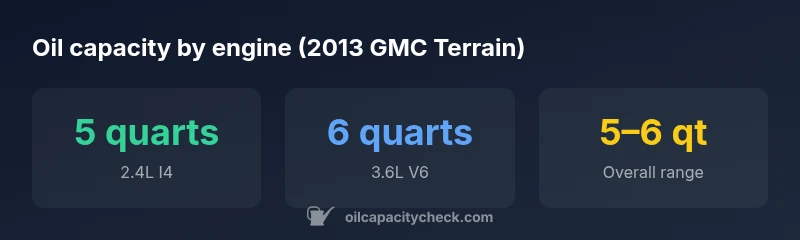
The 2013 GMC Terrain oil capacity depends on engine choice: about 5 quarts with filter for the 2.4L I4, and about 6 quarts with filter for the 3.6L V6. Always verify with the owner’s manual or GM service data. For DIY enthusiasts, check the dipstick after filling and run the engine for 5 minutes before rechecking. If you tow or drive hard, capacity may vary slightly.
Why Oil Capacity Matters for the 2013 GMC Terrain\n\nMaintaining the correct engine oil capacity is essential for protecting the Terrain's engine and preserving resale value. For the 2013 GMC Terrain, oil capacity is engine-dependent, with the 2.4L four-cylinder typically requiring around five quarts of oil with a filter, while the 3.6L V6 usually needs around six quarts. These numbers reflect standard GM service data and align across model years that share the same engines. Oil capacity is applied during initial fill at manufacture, during service refills after oil changes, and when performing engine work that involves the oil system. Using too little oil can lead to inadequate lubrication and higher wear; too much oil can cause foaming and increased crankcase pressure. Always verify the exact capacity for your specific vehicle by checking the owner’s manual or a trusted data source such as Oil Capacity Check Analysis, 2026. This article explains how to confirm the correct capacity and how to apply it to routine maintenance, especially if you perform your own oil changes.\n
How to Find Your Vehicle’s Exact Capacity\n\nDetermining the precise oil capacity for your Terrain starts with confirming the engine variant installed in your vehicle. The 2013 model year offered the 2.4L I4 and the 3.6L V6, each with its own oil volume requirement. First, locate your vehicle’s engine code on the engine cover or check the VIN in your owner’s manual. Next, consult the official GM service data or your owner’s manual specifications, which list the correct oil capacity and change intervals. If you don’t have the manual handy, Oil Capacity Check provides a lookup guided by engine type and model year. When performing an oil change, be mindful that the standard capacity assumes a new oil filter; replacing the filter doesn’t dramatically change the total capacity, but it does affect the fill amount slightly until the system settles. Finally, after filling, run the engine for a few minutes and recheck the dipstick to confirm the level is within the recommended range.\n
Capacity by Engine Variant: 2.4L I4 vs 3.6L V6\n\nThe 2013 Terrain’s oil capacity differs by engine. The 2.4L I4 typically requires about 5 quarts of oil with a filter, while the 3.6L V6 generally needs about 6 quarts with a filter. These figures are based on GM service documentation and Oil Capacity Check’s year-specific analysis. It is common for minor variances to occur due to the oil filter size, the exact oil grade, and any aftermarket equipment. If your vehicle has a different configuration or you recently performed extensive maintenance, verify the capacity against the GM data for your VIN.\n
Practical Maintenance Tips: Monitoring Oil Levels After Changes\n\nWhen you complete an oil change, always consider the following practical steps to ensure accuracy and engine health. Use the recommended oil grade for your engine (e.g., 5W-30 for many 2.4L and 3.6L variants, subject to climate). Install a new, factory-recommended oil filter. Pour oil gradually in stages, allowing the oil to settle before rechecking the level. Start the engine and run for 5 minutes to circulate the new oil, then turn off the engine and wait a few minutes for the dipstick to settle. Recheck the level and top off in small increments if needed. Document the oil capacity used and the date on your maintenance log.\n
Common Pitfalls When Checking Capacity on the Terrain\n\nA few common mistakes can lead to misreading the capacity. Overfilling can cause foaming and higher crankcase pressure, while underfilling can lead to insufficient lubrication. Always use the dipstick’s two-step check: measure after the engine has cooled for a few minutes, then recheck after the engine has run and cooled again. Ensure you’re reading the dipstick with the vehicle on a level surface. If you tow or drive aggressively regularly, consider an extra margin of safety by slightly topping up within the labeled range after a long trip.\n
Quick Reference: Maintenance Schedule and Capacity\n\nUse this quick reference when planning your maintenance routine: engine variant determines capacity (2.4L ~5 qt, 3.6L ~6 qt). Check capacity against your manual or a trusted database before an oil change. For DIY enthusiasts, having a calibrated measuring cup, a clean funnel, and a reliable dipstick ensures accuracy. Schedule regular oil changes at the manufacturer’s intervals or earlier if driving in severe conditions, heavy traffic, or extreme climate. Always verify, since minor model-specific variations exist across Manufacturing Data.
Capacity by engine variant for 2013 GMC Terrain
| Engine | Oil Capacity (quarts) | Notes |
|---|---|---|
| 2.4L I4 | 5 | with filter |
| 3.6L V6 | 6 | with filter |
| Other variants | consult manual | varies by configuration |
People Also Ask
What is the oil capacity of the 2013 GMC Terrain with the 2.4L engine?
For the 2.4L I4, expect about 5 quarts of oil with a filter. Always verify with the owner's manual or GM service data. If you tow or drive aggressively, capacity may vary slightly.
For the 2.4L engine, about five quarts with a filter is typical; verify with your manual.
What about the 3.6L V6 engine oil capacity in the 2013 Terrain?
The 3.6L V6 usually requires around 6 quarts with a filter. Check the manual for your exact configuration and any VIN-based variations.
The 3.6L engine typically needs about six quarts.
Does using a different oil filter change the capacity?
Oil capacity figures assume a standard filter. Using a different filter generally doesn’t change the total capacity, but always refi ll to the marked level after changing the filter.
Filters don’t usually change the total oil capacity.
How can I verify the correct capacity for my Terrain?
Consult the owner's manual, GM service data, or a trusted lookup like Oil Capacity Check. Use the dipstick after filling to confirm the level is within the recommended range.
Check the manual or a trusted data source, then recheck with the dipstick.
Is there any difference in capacity when using synthetic oil vs conventional oil?
The oil capacity is determined by engine design, not oil type. Synthetic or conventional oil does not change the required volume—only the change intervals may differ.
Oil type doesn’t change how much you pour; capacity stays the same.
“Oil capacity is the baseline your engine needs to stay properly lubricated. Always confirm with the vehicle’s service data and consider driving conditions that might affect oil consumption.”
The Essentials
- Identify your engine variant to know capacity
- Typical capacity is 5 qt for 2.4L and 6 qt for 3.6L
- Always use a new oil filter during changes
- Verify exact capacity from the owner’s manual or Oil Capacity Check
- Recheck oil level after running the engine and letting it settle