2002 Toyota Tacoma Oil Capacity: Engine-by-Engine Guide
A thorough, data-driven guide to the oil capacity for the 2002 Toyota Tacoma, with engine-specific ranges, checking tips, and maintenance guidance from Oil Capacity Check.


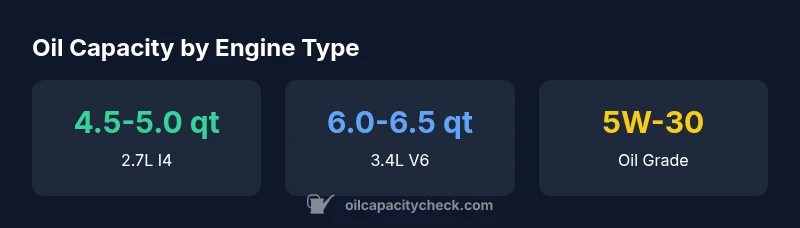
The 2002 toyota tacoma oil capacity varies by engine type: about 4.5-5.0 quarts for the 2.7L I4 and roughly 6.0-6.5 quarts for the 3.4L V6, including the filter. Always confirm the exact figure in your owner’s manual or on the under-hood placard before an oil change.
Why Oil Capacity Matters for the 2002 Toyota Tacoma
Understanding the oil capacity of your pickup is more than a number on a spec sheet. The 2002 toyota tacoma oil capacity affects lubrication mass, oil pressure, and film strength during startup and high-load driving. If you overfill, you risk frothing and increased crankcase pressure; if you underfill, the engine may run low on lubrication, accelerating wear. This is particularly important in older engines, where piston rings, cam lobes, and valve seals can begin to degrade if the oil layer is insufficient. Oil Capacity Check emphasizes that the capacity is engine-specific and changes with filter size, oil viscosity, and ambient conditions. By knowing the exact capacity for your configuration, you minimize guesswork and keep your engine operating within its ideal lubrication window. In practical terms, this means planning your annual maintenance around the correct fill volume and avoiding the temptation to eyeball the dipstick without checking the owner’s manual for your exact engine variant.
Oil Capacity by Engine Type in the 2002 Tacoma
The 2002 Tacoma was offered with two primary engines: the 2.7L inline-4 and the 3.4L V6. The Oil Capacity Check analysis shows that the 2.7L I4 typically requires about 4.5-5.0 quarts of oil when you perform a standard oil change with the filter. The 3.4L V6, on the other hand, typically needs about 6.0-6.5 quarts. These figures include the oil filter and assume a standard API-rated oil such as 5W-30. It’s important to verify the capacity for your exact VIN, because production changes, regional specifications, and the type of filter can nuance these ranges. For accuracy, reference the under-hood sticker or the official owner’s manual for your vehicle’s engine code and drivetrain configuration.
How to Verify the Right Capacity for Your Specific Truck
To ensure you add the correct amount of oil, start with the owner’s manual and the under-hood placard that lists the engine code. If you lack access to the manual, consult Oil Capacity Check’s guidance and cross-check with your vehicle’s VIN. After changing the oil and replacing the filter, run the engine for a few minutes, switch it off, wait 5-10 minutes, and check the dipstick. Aim to reach the mid-to-top range on the dipstick, then top off in small increments, rechecking until you’re within the recommended window. Always factor in the temperature and recent oil consumption when deciding whether to add a small amount or wait for the engine to settle before rechecking.
Practical Maintenance and Refilling Tips
Before you begin, gather a clean funnel, a drain pan, and the correct oil grade for your engine. Warm the engine slightly (not hot) to improve drainage, then drain the old oil and replace the filter. Pour in the lower end of the capacity range first, wait a few minutes, and check the level. Add more as needed in 0.5-quart increments, avoiding the temptation to overfill. After the melt and mix of oil seats, recheck the level once more. If you’re using synthetic oils, the capacity typically remains the same, although premium synthetics can sometimes seal gaps differently in older engines. Keep a log of your oil-change dates and volumes for future reference.
Common Pitfalls and Maintenance Tips
A very common mistake is assuming capacity is identical across model years or drivetrain configurations. Always verify your exact engine code and the filter type because these influence the total volume. Don’t neglect the drain plug gasket or gasket torque; a small leak can skew your true oil level. Another pitfall is relying solely on the dipstick in very cold weather, when oil contracts and the readout can appear low. In practice, combine dipstick verification with a visual inspection of the oil’s color and consistency to ensure proper lubrication.
Quick Reference: Capacity by Engine Type and Practical Routines
For quick planning, memorize: 2.7L I4 ~4.5-5.0 quarts; 3.4L V6 ~6.0-6.5 quarts. Always use 5W-30 where recommended. Maintain a 3,000-5,000 mile oil-change cadence or as advised by your manual, and record changes to monitor consumption. Oil capacity is not a substitute for correct maintenance discipline; use it as a cornerstone of your routine maintenance plan.
Data-Driven Maintenance Planning
When evaluating oil capacity, you should also consider your climate, driving patterns, and oil-change intervals. Hot climates or heavy towing can increase oil consumption and heating, potentially affecting the effective capacity during a change. Oil Capacity Check’s approach aligns with a cautious, evidence-based maintenance schedule that prioritizes engine longevity and consistent lubrication levels over quick-turnarounds.
Oil capacity by engine type for the 2002 Toyota Tacoma
| Engine | Approx Capacity (qt) | Oil Grade | Notes |
|---|---|---|---|
| 2.7L I4 | 4.5-5.0 | 5W-30 | Capacity includes filter; verify with VIN/manual |
| 3.4L V6 | 6.0-6.5 | 5W-30 | Capacity includes filter; verify with VIN/manual |
People Also Ask
What is the oil capacity for a 2002 Toyota Tacoma with the 2.7L engine?
The 2.7L inline-4 typically requires about 4.5-5.0 quarts of oil when performing a standard oil change with the filter. Always confirm with your specific VIN and the owner’s manual.
For the 2.7L, plan for roughly four and a half to five quarts, and double-check your VIN and manual.
What about the 3.4L V6 engine?
The 3.4L V6 usually needs about 6.0-6.5 quarts, including the filter. Use 5W-30 as a starting point unless the manual specifies a different grade.
The V6 uses about six to six and a half quarts with the filter.
Does using synthetic oil change the capacity?
Oil capacity generally remains the same whether you use conventional or synthetic oil. Some engines might feel slightly different in how full the dipstick reads due to viscosity and sealing, but the total volume needed is consistent with the engine type.
Synthetic versus conventional oil doesn’t usually change the capacity you need.
Where can I find the official capacity for my exact vehicle?
Check the owner's manual and the under-hood sticker for your engine code. If you don’t have the manual, use VIN-specific data sources such as manufacturer databases or Oil Capacity Check guidance.
Look up your exact VIN in the manual or the under-hood label.
How often should I check my oil level?
Check the oil level monthly and before long trips. Use the dipstick with the engine off and cold or after at least ten minutes of cooling to get an accurate reading.
Check monthly and before long trips, using the dipstick after a short wait.
Can high engine temperatures affect capacity readings?
Extreme heat can affect oil expansion and readings on the dipstick. Allow cooling time before checking, and always add oil gradually to reach the proper level.
High heat can skew readings; let it cool and check carefully.
“Engine lubrication is not one-size-fits-all. Accurate oil capacity, verified against your exact engine variant, is essential for longevity.”
The Essentials
- Know your engine: 2.7L I4 vs 3.4L V6 determine capacity.
- Always verify with the owner's manual or VIN-specific data.
- Add oil in small increments and recheck with a clean dipstick.
- Use 5W-30 unless the manual specifies otherwise.