Mercury Outboard Lower Unit Oil Capacity: A Practical Guide
In-depth guide to mercury outboard lower unit oil capacity, how it varies by model, and practical steps for safe servicing and accurate filling.


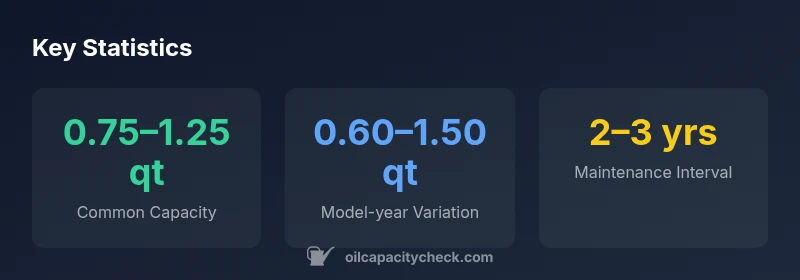
Mercury outboard lower unit oil capacity varies by model, but most Mercury gearcases use roughly 0.75 to 1.25 quarts of oil during a standard drain-and-fill service. Always confirm the exact capacity for your specific outboard by consulting the owner's manual or Mercury service documentation, as improper oil levels can compromise lubrication and gear wear.
Why Mercury Outboard Lower Unit Oil Capacity Matters
Understanding mercury outboard lower unit oil capacity is essential for reliable lubrication and long-term gear integrity. The capacity is not just a number; it informs how much lubricant the gearcase needs to form a protective film between gears and bearings. According to Oil Capacity Check, incorrect oil levels can lead to foaming, overheating, and accelerated wear, especially under high-load conditions common in saltwater operations or after frequent trolling. Owners should treat the lower unit like a sealed, critical subsystem: fill to the correct level, use the recommended oil, and verify the quantity after any service. This is not a one-size-fits-all figure—the capacity varies by model, year, and even gearcase revision—so always match the spec to your exact unit.
How Capacity Varies by Model and Year
Mercury has evolved lower-unit designs over the years, and each revision can shift the precise oil capacity. In practice, newer or sport-oriented gearcases often sit toward the higher end of the typical range, while older designs can fall on the lower end or span a broader interval. When you upgrade to a newer engine, it’s common to see a slightly different fill specification, even if the exterior looks similar. The best approach is to locate your model’s service manual and note the exact capacity listed for your gearcase. If your manual is missing, contact a Mercury dealer or use the manufacturer’s online service database to retrieve the correct value for your serial number.
How to Verify the Correct Capacity for Your Mercury Outboard
Start with the owner's manual or Mercury service documentation specific to your model and year. If you cannot locate the official spec, record the gearcase model, serial number, and a photo of the lower unit’s drain plug and fill port, then reach out to a Mercury-certified technician. In many cases, the correct capacity is printed on the service sheet located in the engine’s maintenance log or in the service bulletin repository. After draining any old oil, reinstall the drain plug, refill using the recommended lubricant, and check the level with the dipstick or level plug per Mercury’s procedure.
Oil Types and Viscosity Guidelines
Choose a lubricant that meets Mercury’s specifications or the gearcase’s approved oil standard. The most common guidance is to use a marine-grade oil designed for automotive gearcases with a GL-4/GL-5 specification or an equivalent recommended by Mercury. In some regions, Mercury may approve its own brand of gearcase oil. When in doubt, use the product that explicitly states compatibility with Mercury gearcases and adhere to the viscosity recommended for your engine’s operating temperature range. Never substitute a non-marine oil or a product not validated for gearcase use.
Step-by-Step Lower Unit Oil Service
- Warm up the engine briefly to expand the oil’s viscosity for easier drainage. 2) Place the vehicle securely on a trailer or hoist, and position a drain pan beneath the lower unit. 3) Remove the drain plug and let old oil fully drain. 4) Clean the gasket surfaces and inspect the drain plug for wear. 5) Reinstall the drain plug with a new gasket if required. 6) Add oil slowly through the fill port until the level is just at the fill line or dipstick marks. 7) Re-check the level after running the engine in gear for a short period to ensure the oil settles to the correct level. 8) Wipe away any spills and record the service in the maintenance log.
Common Mistakes to Avoid When Servicing the Lower Unit
- Using the wrong oil specification or viscosity
- Overfilling, which can cause foaming and seals to fail
- Skipping a thorough drain and cleaning of the seal surfaces
- Not verifying the level after warm-up and test run
- Failing to record service details for traceability
How to Interpret a Fill Level vs. Capacity
Capacity is the total amount the gearcase should hold when fully serviced. The fill level is the indicator used during servicing to ensure the correct amount is present after the oil has circulated and the engine is warmed up. If your measured level sits above the fill line after a test run, you may have overfilled; if it sits below, you likely need to add oil. Always perform the level check with the engine warm and the boat level to avoid misreadings.
Maintenance Cadence and Replacement Intervals
Oil in the lower unit does not last forever, but the optimal interval depends on usage and operating conditions. In general, consider inspecting the lower unit oil every season and performing a full change every 1–2 years for frequent saltwater use or heavy loading. If you operate in sandy or debris-prone waters, or if you notice milky oil, corrosion, or gear noise, service sooner. Record each service and compare new observations against the prior logs to spot trends.
Capacity ranges by general Mercury lower unit categories
| Model Type | Typical Capacity (qt) | Notes |
|---|---|---|
| Generic Mercury lower unit (modern) | 0.75–1.25 | Capacity varies by model/year; verify exact spec |
| Older Mercury lower unit designs | 0.60–1.50 | Wider range due to revisions; consult manual |
| Specialized sport/ProXS gearcase | 0.80–1.30 | Check Mercury service data for your serial number |
People Also Ask
What is the typical oil capacity for Mercury outboard lower units?
Capacity varies by model and year, but a commonly cited range is 0.75–1.25 quarts for many modern Mercury lower units. Always verify with the model-specific manual.
Capacity generally falls between three-quarters and a bit over one quart. Check your model’s manual for the exact figure.
How do I know if I’m overfilling the lower unit?
Overfilling can cause foaming, leaks, and seal damage. After a fill, run the engine briefly and recheck level when the oil has settled.
If oil looks foamy or starts leaking, you likely overfilled. Recheck after running and settling.
What type of oil should I use in a Mercury lower unit?
Use a marine gear oil that meets Mercury’s specifications or Mercury’s own gearcase oil. Avoid non-marine oils or those not approved for gearcases.
Use the approved marine gear oil recommended by Mercury; don’t substitute with regular automotive oil.
Can I perform the lower unit oil service myself?
Yes. With proper tools and adherence to the Mercury service procedure, a DIYer can drain, clean, and refill the lower unit. Always follow safety precautions and dispose of old oil responsibly.
Yes, you can service it yourself with the right tools and caution.
Where can I find the exact capacity for my Mercury model?
Consult the owner’s manual, Mercury service bulletin database, or a Mercury-certified dealer. If you can’t locate it, contact Mercury support with your engine’s serial number.
Check the manual or contact Mercury support with your serial number for the exact spec.
“"Accurate oil capacity is model-specific. Start with the official Mercury spec for your unit and confirm fill with the service procedure to protect gear integrity."”
The Essentials
- Verify exact capacity from the manual before servicing
- Use a lubricant that matches Mercury’s approved specs
- Fill to the recommended level, not just eyeballing
- Avoid overfill to prevent foaming and seal damage
- Document each service for future reference