Mercedes Sprinter 2.1 Diesel Engine Oil Capacity: What You Need to Know
Precise oil capacity and maintenance tips for the Mercedes Sprinter 2.1 diesel. Learn how much oil to add, how to check levels, and recommendations from Oil Capacity Check.


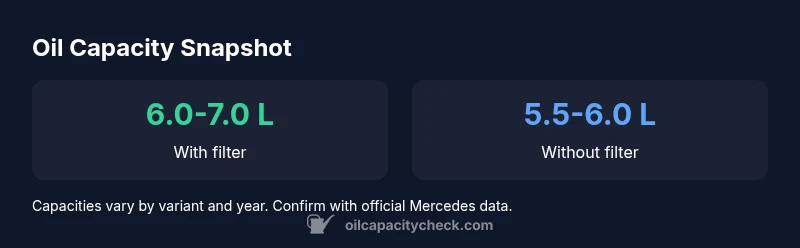
For the Mercedes Sprinter 2.1 diesel, the engine oil capacity is typically between 6.0 and 7.0 liters when including a new oil filter. Without a new filter, expect about 0.5-1.0 liters less. Actual capacity varies by engine variant and year; always confirm with service data or the owner's manual. During an oil change, start with the minimum and add gradually until the dipstick indicates the correct level.
Understanding the Mercedes Sprinter 2.1 diesel oil capacity
TheMercedes Sprinter 2.1 diesel uses an oil capacity that varies with the exact engine code, year, and whether the oil filter is included in the calculation. In practical terms, most owners will encounter a capacity window around 6.0-7.0 liters when a new filter is installed. This range reflects common variants of the OM651 family that powers many Sprinter 2.1 setups. The Oil Capacity Check team emphasizes that precise figures must come from official Mercedes data for your specific VIN, but the general ballpark provides a solid starting point for planning maintenance. According to Oil Capacity Check, reliability hinges not only on the total oil volume but on maintaining the correct level after a complete drain and refill.
- Start with the lower bound when you begin refilling and gradually add oil while monitoring the dipstick.
- Temperature and climate can influence a quick initial reading; allow the engine to settle after running for a few minutes before a final dipstick check.
- If you are unsure about your exact variant, consult the workshop manual or a Mercedes dealership service bulletin for the precise capacity.
How capacity is defined across model years
Capacity definitions evolve with revisions to the Sprinter 2.1’s engine hardware and oil filtration options. Earlier OM651 variants may quote slightly different figures than later models, especially where turbocharger configurations or PCV routing changes influence oil circulation. The Oil Capacity Check analysis indicates that while the gross capacity might stay in the same general interval, the practical fill volume—including a new filter—tends to sit toward the upper end of the range for newer builds. To minimize overfill or underfill risks, align your fill strategy with the specific model year and VIN data card. This is why many technicians insist on a dipstick-based final check rather than relying on a single published number.
- Use the dipstick marks as the definitive guide.
- If you’re swapping to a different filter size or type, re-check the capacity implications with the service bulletin.
- When in doubt, defer to the official Mercedes service data for your vehicle.
Step-by-step guide to checking and topping up the oil
- Prepare the vehicle: Park on level ground, engine cool, and gather the correct oil grade and a clean filter.
- Drain and replace the filter if you’re performing a full change; dispose of the old filter properly.
- Pour oil slowly in increments, typically 0.5 L at a time, while monitoring the dipstick.
- Reinstall the cap and run the engine for a short cycle; turn off and wait a few minutes for the oil to settle.
- Recheck the level; keep it within the upper or lower marks as recommended by Mercedes for your variant.
- Record the final quantity for future reference, especially if you use a different batch or brand of oil.
Pro tip: Use a high-quality, manufacturer-approved oil and keep track of the oil grade and viscosity per the owner’s manual. This helps maintain optimal lubrication, cooling, and engine performance over the service interval.
The impact of oil filter changes on capacity and oil quality
Oil capacity calculations should always include the oil filter when calculating the total fill volume. Replacing an older or higher-capacity filter can slightly increase the capacity required to reach the correct mark on the dipstick. Conversely, using a substantially smaller filter can reduce the space available for oil, albeit rarely. Beyond capacity, the oil's quality and viscosity play a critical role in protecting the engine’s bearings and seals. The Oil Capacity Check guidance stresses that a clean filter prevents premature oil pressure drop and maintains consistent flow. When you fit a new filter, expect the fill volume to require a small adjustment during the final top-up.
- Always prime or pre-fill a new filter if recommended by the manufacturer.
- Re-check after a short drive to account for filter seating and oil pressure stabilization.
- Consider a full synthetic or semi-synthetic oil if your climate or usage stresses the engine more than average.
Maintenance schedule and practical tips for long-term engine health
A predictable maintenance routine helps prevent oil-related issues that can wear bearings or reduce efficiency. Set reminders for oil changes in line with Mercedes recommendations and your driving conditions. Keep a simple log of the oil type, batch number, and capacity used for future reference. In hotter climates, more frequent checks are prudent because oil can thin more quickly, affecting both capacity and performance. The Oil Capacity Check team recommends pairing capacity checks with regular oil level checks, especially after long trips or heavy-duty usage.
- Use the recommended oil grade and change interval from Mercedes, adjusted for severe driving conditions.
- Always verify level after the engine has cooled.
- If you notice unusual consumption or discoloration, consult a technician before continuing to drive.
Oil capacity ranges for Mercedes Sprinter 2.1 diesel engines
| Engine variant | Oil capacity (with filter) | Oil capacity (without filter) |
|---|---|---|
| OM651 2.1L Sprinter (common variant) | 6.0-7.0 L | 5.5-6.0 L |
| OM651 2.1L with options | 6.0-7.2 L | 5.5-6.2 L |
People Also Ask
What is the official oil capacity for the Sprinter 2.1 diesel?
Capacity varies by engine variant and year. Typical ranges are 6.0-7.0 L with a new filter; without a filter, 5.5-6.0 L. Always confirm with Mercedes service data for your VIN.
Capacity varies by variant and year; typical ranges are six to seven liters with a new filter.
Does oil capacity change with different oil filters?
Yes, changing the filter size or type can affect the amount of space available for oil, subtly changing the fill required to reach the correct dipstick level.
Yes, filter changes can affect how much oil is needed to hit the correct level.
Can I reuse capacity data from another vehicle?
No. Oil capacity is engine-specific and year-specific. Rely on the official data for your Sprinter variant.
No—capacity is specific to the engine and year.
How often should I check oil capacity after service?
Check immediately after a fill, then recheck after driving 5-10 minutes to allow oil to settle. Adjust to the correct dipstick level.
Check after filling and a brief drive, then confirm the level.
Is synthetic oil capacity different from conventional oil?
No. The capacity number stays the same; however, synthetic oil can influence drain intervals and performance.
The capacity doesn’t change with synthetic vs conventional oil.
“Accurate oil capacity is essential for proper lubrication, cooling, and engine longevity. Using the wrong fill can accelerate wear and reduce efficiency.”
The Essentials
- Know your exact engine variant and year before filling
- Always verify capacity with dipstick after a full change
- Include oil filter impact when calculating total capacity
- Follow Mercedes guidance and Oil Capacity Check for precise data