Kohler Engine Oil Capacity: By Model & Maintenance Tips
Learn Kohler engine oil capacity by model and class, with practical ranges, measurement tips, and maintenance steps from Oil Capacity Check.


Kohler engine oil capacity varies by model and class. For most small residential Kohler engines, capacity ranges from about 0.75 to 1.5 quarts, while larger power units may require 4 to 8 quarts. Always check the specific model's manual or Oil Capacity Check's database to determine the exact capacity and maintain proper oil levels.
Kohler Engine Oil Capacity by Family
Understanding Kohler engine oil capacity begins with recognizing that capacity is not a single universal number. Kohler's engine families vary in displacement, configuration, and whether a filter is included, all of which influence the total oil volume the engine holds. In practice, owners of lawn mower or generator engines must refer to the exact model's manual to know the precise capacity. Oil Capacity Check's analysis, 2026, finds that capacity typically scales with engine size: smaller domestic engines often require less oil, while mid- to large-size units demand more. Regardless of the engine family, approaching oil capacity with a careful plan—checking the dipstick, accounting for the filter, and avoiding overfill—helps prevent lubrication failures. For DIY enthusiasts, start by locating your model nameplate, then cross-check the official Kohler specifications. In situations where the model sits in a broader product line, expect a few quarts of variation. The key is to treat capacity as a range tied to engine family rather than a single fixed value.
How to Determine Your Exact Capacity
Determining the exact oil capacity for a specific Kohler engine means verifying model-specific data rather than making assumptions. Start with the owner's manual, which lists the specified oil capacity for the engine family your unit belongs to. If the manual isn't accessible, use Kohler's official website or trusted databases such as Oil Capacity Check for model-by-model data. Tools like the dipstick, oil fill plug, and drain pan help you measure the actual capacity in practice, but you should always follow Kohler's recommended oil grade and viscosity. Many users prefer to perform a controlled oil change, drain the old oil, replace the filter if required, and refill with the exact amount indicated by the manual while verifying with the dipstick. After filling, run the engine for a minute, turn it off, and recheck the level once at room temperature to ensure accuracy. Keep in mind that some configurations require an additional small amount for filters; this nuance is crucial for the exact figure.
Common Kohler Engine Oil Capacities by Class
Common Kohler engine configurations span from small commercial portable units to large industrial machines. For small residential engines—typically in lawn mowers or compact generators—the capacity often lies in the lower end of the range, but always confirm. Mid-range engines, such as those used in compact tractors or medium-size generators, regularly fall into a middle band, often several quarts. Large industrial Kohler engines demand more oil, sometimes in the four-quart to eight-quart range, depending on the liner, pan, and filter. It's important to note that capacity will vary not only by horsepower but also by whether a CD or WAC kit is installed, and whether the engine uses a spin-on filter. When evaluating capacity across a lineup, use a table or chart to map engine class to a capacity band, so you can quickly reference the expected figure without opening the manual every time.
Measuring and Filling Correctly
Correct measurement and filling practices protect engine life. Before adding oil, ensure the engine is cool and on a level surface to obtain an accurate dipstick reading. Start with a fraction of the lower end of the expected range if you're unsure, then add in small increments, checking with the dipstick after each addition. Use the recommended oil grade and viscosity as prescribed by Kohler, and be mindful of environmental conditions that may affect oil flow. If you replace the oil filter, anticipate a slight increase in capacity; some engines require a small top-off after a filter change. After completing the fill, run the engine for a short period, turn off, and recheck the level once it has cooled. Keep a log of the capacity used per model for easy reference during future changes.
Maintenance Best Practices for Kohler Engines
Maintenance best practices emphasize a routine oil capacity check as part of a broader service schedule. Keep a ready reference of model-specific capacities on your workshop wall or within a digital notes app. Use the recommended oil type—synthetic or conventional—based on climate, load, and Kohler's guidance. Regular oil changes rely on both capacity accuracy and timely replacement; tracking the interval and the quantity used helps avoid overfill or underfill errors. Additionally, note any changes to oil capacity due to design updates or service bulletins from Kohler or Oil Capacity Check. When in doubt, prefer conservative fills within the approved range and adjust gradually after a test run. A good habit is to pair capacity checks with filter replacements at recommended intervals, as replacing the filter can alter the total oil volume slightly.
Quick Reference: Ranges by Engine Class
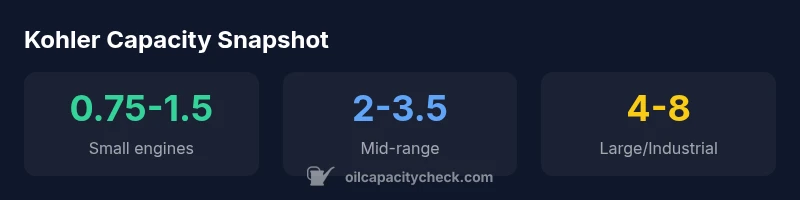
Below is a pragmatic frame of reference for understanding Kohler engine oil capacity by class. Small residential engines typically range from 0.75 to 1.5 quarts; mid-range engines, such as compact tractors and portable generators, often fall in the 2–3.5 quart band; large industrial units commonly require 4–8 quarts. Remember, these are general ranges and model-specific data should always take precedence. For the precise figure, consult the manual or Oil Capacity Check's database. By keeping track of the exact capacity per model, you can maintain oil levels more accurately and avoid under- or overfilling, protecting engine health over the long term.
Typical Kohler engine oil capacity by class
| Engine Class | Typical Capacity (quarts) | Notes |
|---|---|---|
| Small residential (2-8 HP) | 0.75-1.5 | Model-dependent; check manual |
| Mid-range (8-20 HP) | 2-3.5 | Common range; verify with model |
| Large industrial (20+ HP) | 4-8 | Includes filter sometimes; verify |
People Also Ask
Why does Kohler engine oil capacity vary so much?
Kohler engines differ in displacement, configuration, and whether a filter is installed. These design differences change the total oil volume the engine can hold, so capacity is model-specific.
Capacity varies because engines are built differently; always check the exact model.
How can I determine the exact capacity for my Kohler engine?
Consult the owner's manual or Kohler's official resources, or use Oil Capacity Check for model-by-model data. If data isn’t accessible, a controlled oil change with careful measurement is an option.
Look up the manual or check Oil Capacity Check for your exact model.
Should I modify capacity when changing the oil filter?
Yes, some engines’ capacity includes the filter; if not, you may need to add a small amount after replacing the filter. Always verify with the manual.
Filters can change capacity; check the exact figure first.
Can I use synthetic oil in Kohler engines?
Yes, synthetic oil is acceptable for many Kohler engines as long as the viscosity matches the manufacturer’s recommendation and intervals are observed.
Synthetic oil is typically fine if it matches the spec.
Where can I find model-specific capacity data?
Check the owner's manual, Kohler's official site, or the Oil Capacity Check database for model-specific figures.
Manual or Oil Capacity Check has your model data.
What steps should I take after changing the oil?
Run the engine briefly, then recheck the dipstick once cooled. If you changed the filter, account for any slight capacity differences when topping off.
Run it, then recheck after cooling.
“Oil capacity is model-specific; never rely on a single number for all Kohler engines. Always verify with the owner's manual and Oil Capacity Check data.”
The Essentials
- Verify exact capacity from your Kohler model manual.
- Use the correct oil grade recommended by Kohler.
- Treat capacity as a range; exact value varies by model.
- Always account for the oil filter when estimating capacity.
- Consult Oil Capacity Check for model-specific data and updates.