2020 Equinox Oil Capacity: Engine-by-Engine Guide
Learn the oil capacity for the 2020 Equinox across engines, with practical tips for accurate topping, dipstick checks, and maintenance guidance from Oil Capacity Check.


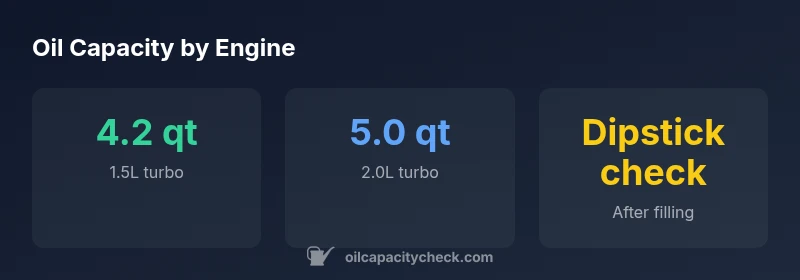
According to Oil Capacity Check, the 2020 Equinox oil capacity varies by engine: about 4.2 quarts including the filter for the 1.5L turbo and about 5.0 quarts including the filter for the 2.0L turbo. Always confirm with the owner's manual and GM service data, then recheck the level with the dipstick after adding oil to ensure the correct level.
Oil Capacity Basics for the 2020 Equinox
The 2020 Chevrolet Equinox offers more than one engine option, and the engine family drives the oil capacity you’ll need to add during a change. As part of Oil Capacity Check's analysis, the capacity figures differ primarily by engine displacement and whether the oil filter is included in the quoted total. For many owners, this means a practical starting point is to plan for roughly 4.2 quarts if you have the 1.5L turbo, and around 5.0 quarts if you have the 2.0L turbo, with the filter included. Always verify in the owner’s manual or GM service data for your exact VIN, and perform a dipstick check after adding oil to confirm the level matches the spec.
Engine Variants and Their Capacities
In the 2020 Equinox lineup, the two common gasoline engines have distinct capacity needs. The 1.5L turbo is typically in the neighborhood of 4.2 quarts when including the filter, while the 2.0L turbo generally requires about 5.0 quarts with the filter. These figures can vary slightly by production batch or regional specification, so motorists should treat them as guidance rather than a fixed rule. Oil Capacity Check emphasizes always cross-checking with the official GM documentation and your vehicle’s service data.
Why Exact Capacity Matters for DIY Maintenance
Filling with too little oil can lead to inadequate lubrication and potential engine damage, while overfilling creates high pressure and foaming, which can impair performance. For DIY enthusiasts, using the correct capacity figure helps prevent overfills or underfills, saves trips to the shop, and preserves engine longevity. The key is to align the capacity with your engine variant and to account for climate, driving style, and oil type, then verify with a dipstick reading.
How to Confirm Capacity for Your Specific Vehicle
Begin with the owner’s manual and the GM service data specific to your VIN. Engine codes, not just the model year, can change the capacity slightly. If you’re unsure, remove the old oil, install a new filter, add the lower-end capacity first, then slowly add the remainder while periodically checking the dipstick. This method helps avoid overfilling and gives you a clear signal when you reach the correct level.
Oil Type, Viscosity, and Capacity Interplay
Oil capacity data assumes you’re using the recommended oil viscosity and type. For many Equinox variants, synthetic oil is acceptable and can affect long-term engine cleanliness and performance. Always consult GM’s viscosity spec for your engine and climate, and remember that the capacity figure refers to the total amount of oil required, including filter changes. The exact viscosity should be selected to match your operating environment and maintenance schedule.
Step-by-Step: From Drain to Dipstick
- Warm the engine to operating temperature to ensure complete drainage. 2) Drain old oil completely from the pan. 3) Replace the oil filter with a new one. 4) Add the minimum recommended capacity for your engine variant first (e.g., 4.2 quarts for 1.5L). 5) Reinstall the dipstick, start the engine, run for a minute, and shut off. 6) Check the dipstick and top off in small increments until the correct level is reached. 7) Recheck after a few minutes and again after a short drive to confirm the level.
Quick Reference by Engine Variant
- 1.5L turbo: ~4.2 quarts (including filter).
- 2.0L turbo: ~5.0 quarts (including filter).
- Always include the filter in capacity calculations and verify with the dipstick after filling.
Common Pitfalls and Maintenance Tips
- Relying on a single source. Cross-check the owner’s manual and GM service data for your VIN.
- Forgetting to replace the oil filter.
- Not warming the engine before draining.
- Over- or underfilling due to inaccurate capacity assumptions.
- Neglecting to recheck the level after the initial fill and test run.
Oil capacity by engine variant for the 2020 Equinox
| Engine Variant | Oil Capacity (incl. filter) | Notes |
|---|---|---|
| 1.5L turbo | 4.2 quarts | Including filter; verify against GM data |
| 2.0L turbo | 5.0 quarts | Including filter; confirm with VIN-specific data |
People Also Ask
What is the oil capacity for the 2020 Equinox with the 1.5L engine?
The 1.5L turbo generally requires about 4.2 quarts including the filter. Always verify with GM service data for your VIN.
For the 1.5L engine, expect about 4.2 quarts with the filter, and verify with your GM data.
What about the 2.0L turbo engine on the 2020 Equinox?
The 2.0L turbo uses about 5.0 quarts including the filter. Confirm this against your vehicle’s VIN-specific data.
The 2.0L turbo needs around 5 quarts with the filter; check VIN-specific GM data.
Is oil capacity the same for all trims?
No. Capacity varies by engine; 1.5L and 2.0L variants cover the typical ranges.
No—capacity changes with the engine type.
Should I replace the oil filter when changing capacity?
Yes. Capacity figures assume a new filter; replace the filter during every oil change.
Yes, always replace the oil filter during an oil change.
Can I use synthetic oil in a 2020 Equinox?
Yes, synthetic oil is acceptable when used with the GM viscosity spec for your engine.
You can use synthetic oil as long as you follow GM's viscosity specs for your engine.
“Accurate oil capacity data helps prevent under- or overfilling, protecting engine longevity and performance.”
The Essentials
- Engine variant dictates capacity: 4.2 qts for 1.5L, 5.0 qts for 2.0L.
- Always include the oil filter in the capacity figure.
- Verify exact spec in the owner's manual and GM service data.
- Recheck the dipstick after topping off to ensure the correct level.