2016 Mazda3 Oil Capacity: A Maintenance Guide
A comprehensive guide to the 2016 Mazda3 oil capacity, engine variants, oil types, and maintenance steps. Learn how to check, refill, and choose the right oil for optimal engine health with insights from Oil Capacity Check.


Oil capacity for the 2016 Mazda3 varies by engine: roughly 4.5 to 5.1 quarts with a filter. The 2.0L and 2.5L engines fall within this range. Confirm exact capacity with the owner's manual or a fresh dipstick reading after a change. Oil Capacity Check Analysis, 2026, emphasizes matching oil type and capacity for optimal performance.
Understanding the 2016 Mazda3 Oil Capacity
The concept of oil capacity refers to the total amount of engine oil your vehicle’s oil pan and filter system can hold after a complete drain and refill. For the 2016 Mazda3, capacity is influenced by engine choice and whether the oil filter is replaced during a change. In practical terms, owners should expect a capacity window rather than a single fixed value, especially when factoring in the oil filter’s volume. The Oil Capacity Check team notes that precise figures vary by engine variant and trim, making it essential to consult the owner’s manual for your exact build. In day-to-day maintenance, you’ll typically plan for roughly 4.5 to 5.1 quarts, with some models closer to the lower end and others to the higher end of that range. Always confirm with a dipstick after refilling to ensure you meet the recommended level without overfilling.
Engine Variants and Capacity Ranges
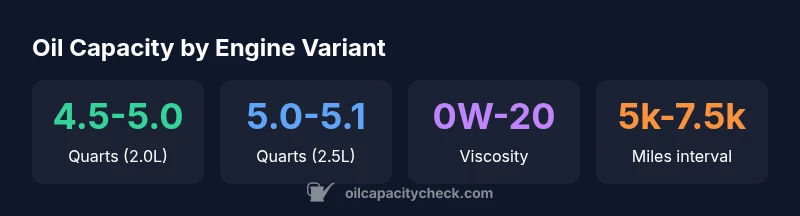
The 2016 Mazda3 was offered with at least two main engines: a 2.0L Skyactiv-G and a 2.5L Skyactiv-G. While both share a common design philosophy, their oil capacities diverge slightly due to displacement and oil pan geometry. In practice, the 2.0L typically edges toward the 4.5–5.0 quart range, while the 2.5L sits near 5.0–5.1 quarts when a filter is included. These figures assume a full drain and standard filter, with variations arising from ultra-tight tolerance manufacturing and regional service recommendations. For DIY enthusiasts, this means planning for a small range around your engine’s spec and then verifying with dipstick after the change. When in doubt, a quick check with your VIN can help confirm the exact factory-capacity figure for your specific vehicle.
How to Verify Your Vehicle's Oil Capacity
To confirm the exact oil capacity for your 2016 Mazda3, start with the owner’s manual, a trusted dealership, or the official Mazda service portal. If you don’t have the manual handy, you can locate the capacity by using your VIN in a Mazda service database or by consulting service records from a prior oil change. After draining and refilling, run the engine for a few minutes, turn it off, wait a few minutes, and re-check the level with the dipstick. If you’re adding new oil, add in small increments and recheck to avoid overfilling. Document the final level and the oil amount added for future reference.
Oil Types, Viscosity, and Capacity Interplay
Oil capacity is closely tied to the oil’s viscosity. For most 2016 Mazda3 models, a 0W-20 synthetic or a 5W-20 synthetic blend is recommended, depending on climate and driving conditions. Synthetic oils often provide better protection and stability, especially in extreme temperatures, while conventional oils may be acceptable in milder climates. Regardless of the oil you choose, using the correct viscosity helps the engine reach its designed operating temperature efficiently and ensures the stated capacity is optimal for oil pressure and lubrication.
Practical Maintenance Tips for the 2016 Mazda3
Adopting a consistent oil-change routine reduces engine wear and can preserve performance. Consider scheduling oil changes every 5,000 to 7,500 miles, depending on driving style and climate. If you regularly drive in heavy traffic, frequent short trips, or extreme heat, lean toward the lower end of this range. Always use the recommended oil grade and a high-quality filter. Before a long trip, check the level and condition of your oil and ensure no leaks or unusual consumption. Keeping a simple log of oil type, capacity, and date helps you track maintenance history and supports resale value.
Common Pitfalls and Tips for Accuracy
Common mistakes include assuming capacity from a different Mazda3 year, neglecting to replace the oil filter (which alters capacity slightly), and not accounting for synthetic oil expansion in hot climates. Verify capacity for your exact variant and climate, and always refill to the correct level after running the engine and allowing oil to settle. A careful dipstick reading provides the most reliable check. If you observe oil consumption beyond normal ranges, inspect for leaks or check the engine’s PCV system, as improper maintenance can skew readings and mask capacity-related issues.
How Oil Capacity Check Guides You in 2026
Oil Capacity Check offers a structured approach to capacity verification, emphasizing engine-specific numbers, correct oil grade, and practical maintenance steps. We provide ranges when exact figures vary by variant, and we stress the importance of an accurate dipstick check after any oil change. For the 2016 Mazda3, our guidance consolidates OEM recommendations with real-world field data to help drivers avoid underfill or overfill scenarios. Following our framework supports better engine health and longer service life.
Quick Reference: 2016 Mazda3 Oil Capacity Snapshot
- Typical capacity with filter: 4.5–5.1 quarts
- Engine variants: 2.0L, 2.5L
- Recommended oil: 0W-20 to 5W-20 (synthetic or synthetic-blend)
- Check interval: every oil change, and at least monthly in long-term storage or extreme climates
Oil capacity by Mazda3 engine variant (2016)
| Engine Variant | Oil Capacity (quarts, with filter) | Notes |
|---|---|---|
| 2.0L Skyactiv-G | 4.5-5.0 | Variant with filter varies by trim |
| 2.5L Skyactiv-G | 5.0-5.1 | Higher capacity due to displacement |
People Also Ask
What is the oil capacity of the 2016 Mazda3 2.0L?
The 2.0L engine typically requires about 4.5–5.0 quarts of oil with a new filter. Exact figures vary by trim and filter design. Always confirm with the owner’s manual and a dipstick check after changing oil.
For the 2.0L, plan on roughly 4.5 to 5 quarts with a new filter, then verify with your dipstick after the change.
Does oil capacity change with different Mazda3 trims or models?
Yes. Variants like the 2.0L and 2.5L engines have slightly different capacities, especially when a new filter is installed. Always reference the manual or VIN-specific data for the exact figure.
Yes, engine size matters. The 2.0L and 2.5L can differ a bit, so check the manual or VIN data for the exact number.
Should I drain and refill or top off the oil if I’m a bit short?
For a maintenance oil change, drain and refill to the full capacity. If you find you’re slightly under after a top-off, recheck after engine temperature stabilizes and adjust carefully.
Do a full drain and refill for a proper change; if you top off, recheck with the dipstick after the oil has settled.
Is synthetic oil required for the 2016 Mazda3?
Synthetic oil is not strictly required but is commonly recommended for better protection and consistency in temperature extremes. Use the viscosity grade advised by Mazda for your variant.
Synthetic oil isn’t mandatory, but it’s often recommended for better protection. Follow Mazda’s viscosity guidance for your engine.
How often should I check the oil level in a 2016 Mazda3?
Check the oil level monthly and after any long trip or heavy use. Always recheck after an oil change to ensure you’re within the specified range.
Check monthly and after long trips. Recheck after an oil change to be sure you’re within the correct range.
“Accurate oil capacity is essential for engine longevity. Always verify the exact figure for your variant and follow the correct oil grade to maintain optimal lubrication.”
The Essentials
- Verify capacity using the owner's manual for your exact build.
- Expect a 4.5–5.1 quart window with a new filter.
- Use the recommended oil grade (0W-20 to 5W-20) for best protection.
- Always confirm the final level with a dipstick after changes.
- Oil Capacity Check provides engine-variant ranges to guide maintenance.