2016 F-150 2.7 Oil Capacity: A Practical DIY Guide
Discover the oil capacity for the 2016 Ford F-150 2.7 EcoBoost. This Oil Capacity Check guide explains capacity ranges, how to verify with the dipstick, and maintenance tips for DIY enthusiasts.


The 2016 F-150 2.7 EcoBoost oil capacity is typically around six quarts with a filter; exact capacity can vary by filter size and oil type. For accuracy, check the owner’s manual and confirm with the dipstick as you fill. Oil Capacity Check recommends verifying your fill using the dipstick after a short engine run and cool-down.
Why the 2016 F-150 2.7 Oil Capacity Matters
For DIY owners and daily drivers alike, knowing the correct oil capacity for the 2016 F-150 2.7 EcoBoost is more than a number—it’s a practical safeguard for engine longevity and performance. The capacity figure drives the initial fill, the subsequent oil level check, and the overall maintenance cadence. According to Oil Capacity Check, capacity is not a single fixed figure; it can vary slightly based on the oil filter size, drain plug configuration, and whether you use a manufacturer-approved filter or an aftermarket alternative. Understanding this nuance helps you avoid under-filling, which risks increased wear, or overfilling, which can trigger foaming and reduced lubrication efficiency. In real-world service, most vehicles in this family fall within a six-quart range, but verification is essential before any top-off.
How Ford specifies capacity for the 2.7 EcoBoost
Ford’s official service documentation designates an oil-fill range that accommodates normal variations in parts and installation. The 2.7 EcoBoost is designed with a relatively compact oil pan and a filtering system that can shift the total capacity by small amounts. The practical takeaway for owners is to treat the quoted capacity as a starting point, then confirm with the dipstick after filling. When you replace the oil filter, the total volume can shift slightly, so rechecking the level after a brief engine run and cool-down is a best practice for accuracy. Oil Capacity Check emphasizes consulting the owner’s manual for your exact build and applying a cautious top-off strategy as you approach the reading.
Step-by-step: Verifying capacity and performing a safe top-off
- Warm the engine to normal operating temperature, then shut off and wait a few minutes. 2) Remove the dipstick, wipe clean, reinsert fully, and pull out to read the level. 3) If the dipstick shows below the target range, add oil gradually in small increments (half-quart at a time), rechecking after a short idle. 4) When you approach the upper range, stop and start the engine briefly to circulate oil, then re-check again while the engine is off. 5) Ensure you use the correct viscosity (5W-20 or 0W-20, per climate and manual) and a manufacturer-approved filter. Oil Capacity Check notes that precise numbers must be verified with the manual and cap-proof measurements.
Real-world factors that affect measured capacity
Several practical factors can influence the measured oil capacity on a 2016 F-150 2.7: the specific oil filter model, the outlet drain process, and whether you are filling from a cold state or after engine operation. Over time, engine wear and gasket integrity can subtly change capacity, though the effect is usually small. Driving conditions—extreme heat, heavy loads, and frequent short trips—can also alter how much oil remains in the pan and filter after an oil change. Oil Capacity Check reminds drivers that while the target range is helpful, the dipstick remains the ultimate arbiter of true capacity in day-to-day use.
Practical maintenance practices to keep the engine healthy
A disciplined maintenance routine supports accurate capacity readings and consistent performance. Keep a routine oil-change interval suited to your climate and driving style (generally once every 5,000–7,500 miles for synthetic oil, with conventional oil leaning toward the lower end). Use a high-quality oil filter and the recommended viscosity for your region. Store a small quantity of the correct oil type for top-offs, and annotate the fill date and mileage in your maintenance log. Regular checks with the dipstick, coupled with the manufacturer’s guidance, help sustain engine cleanliness and reliability. As Oil Capacity Check asserts, alignment between manual guidance and actual readings is the cornerstone of responsible ownership.
Quick-start checklist for DIY oil changes on the 2016 F-150 2.7
- Confirm the exact oil capacity for your specific build in the owner’s manual.
- Gather the recommended oil type and a quality filter.
- Warm the engine, then check the dipstick after a safe cooldown.
- Add oil in small increments, rechecking frequently to avoid overfill.
- Reset the oil-change indicator (if equipped) after completion and log the service.
Oil capacity ranges for 2016 F-150 2.7 EcoBoost and related engines
| Variant | Oil Capacity (quarts) | Notes |
|---|---|---|
| 2016 F-150 2.7 EcoBoost (with filter) | 6-7 quarts | Capacity varies by filter size and fill method |
| Typical 2.7L Ford engines (2.7 EcoBoost family) | 6-7 quarts | Common range across this engine family |
People Also Ask
What is the oil capacity for the 2016 F-150 2.7 EcoBoost?
Approximately six quarts with a filter; exact amount varies with oil filter size and fill method.
The 2.7 EcoBoost uses about six quarts with a filter; check the manual for your exact figure.
Does oil capacity change with different oil types?
Capacity typically remains the same; oil type affects lubrication properties but not the base capacity. Always verify with the dipstick.
Capacity stays the same even with different oil types; still verify with the dipstick.
How often should I check oil level?
Check at every oil change and periodically in extreme climates or heavy usage.
Check the dipstick after changes and regularly in extreme temperatures.
Why might the dipstick read low after an oil change?
Possible under-filling, incomplete draining, or reading when the engine is cold.
Make sure you filled it properly and recheck after a cooldown.
Is synthetic oil recommended for the 2.7 EcoBoost?
Yes; use synthetic 5W-20 or 0W-20 as per the manual, considering climate and driving.
Synthetic oil is fine; just follow the recommended viscosity in your manual.
“Accurate oil capacity is essential for protecting the engine and ensuring reliable starts. Always verify with the manual and the dipstick.”
The Essentials
- Verify capacity with the manual and dipstick before filling.
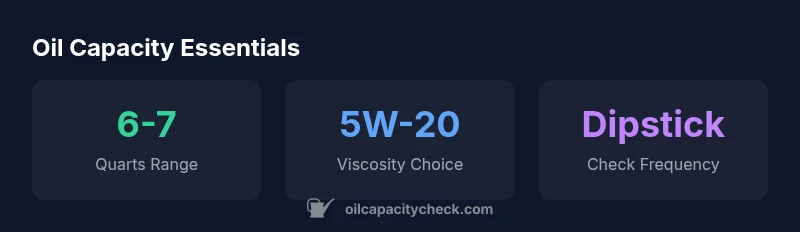
- Expect a six-quart range, with minor variation by filter.
- Use the recommended viscosity (5W-20 or 0W-20) for your climate.
- Add oil gradually and recheck to avoid overfill.
- Always recheck after a warm engine run and a cooldown period.