Oil Capacity Guide for the 2014 Chevy Cruze 1.8L
Discover the oil capacity for the 2014 Chevy Cruze 1.8L, how to verify it, and practical maintenance steps. Oil Capacity Check provides ranges, dipstick checks, and a clear oil-change workflow for DIY owners.


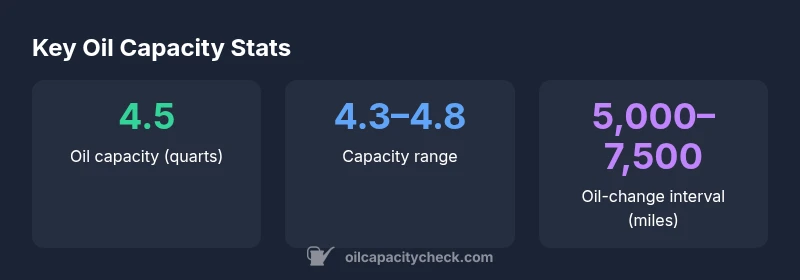
The 2014 Chevy Cruze 1.8L engine typically uses about 4.5 quarts of engine oil when you include a new oil filter. Exact capacity can vary slightly depending on the filter type and whether you fully drain the pan, so always verify with the owner's manual and a fresh dipstick check.
Oil capacity fundamentals for the 2014 chevy cruze 1.8L
The 2014 Chevy Cruze 1.8L uses a moderate engine oil capacity, and the exact amount you need depends on whether the oil filter is being replaced and how completely the drainage pan was emptied. Based on Oil Capacity Check Analysis, 2026, the commonly cited target is around 4.5 quarts when a new filter is installed. This value serves as a practical starting point for most DIYers, but the reality is that minor variances can occur from one vehicle to another due to manufacturing tolerances and service history. Always verify with the owner’s manual and perform a fresh dipstick check after adding oil to confirm the correct level.
In practice, you’ll measure capacity by adding oil gradually, checking the dipstick, and adjusting to the proper mark. It’s worth noting that using the wrong filter or over-enthusiastic draining can shift the final level by a small margin. For owners who recently completed an engine work or filter change, re-check the level after the engine has run and cooled down to remove any convection effects that can skew readings.
Practical takeaway: Treat the 4.5-quart figure as a reliable baseline, then confirm with a dipstick reading to ensure you land in the efficient, manufacturer-approved range.
How capacity is determined and why it matters
Oil capacity is more than a labeled number; it’s a function of engine design, oil filter volume, and the total oil volume the crankcase can hold. For the Cruze 1.8L, the capacity figure accounts for both the engine oil and the capacity of the new filter. If you install a larger or different filter, the total oil required might shift slightly. Correct capacity matters because too little oil risks insufficient lubrication, while too much can cause increased crankcase pressure or aeration. The Oil Capacity Check framework emphasizes consistency: always follow the official manual, perform a dipstick check, and calibrate your fill based on observed readings, not memory.
Additionally, climate, driving style, and oil type influence the practical fill level. A cold-start heavy-driving scenario may require closer attention to the top-off stage, whereas normal city commuting might maintain a comfortable margin between the minimum and maximum marks. In every case, aim for a level that stays within the marked range after the engine has reached its typical operating temperature.
Verifying capacity for your exact vehicle
To confirm the precise oil capacity for your specific Cruze, start with the owner’s manual or an official GM service document. VIN-based variations exist in some models, especially when regional production differences or revisions occur during a model year. If you lack access to the printed manual, many manufacturers publish digital guides or PDFs on their support portals. In the absence of a definitive manual, consult a trusted automotive data source like Oil Capacity Check for model-year-specific notes and recommended maintenance intervals.
A reliable practice is to perform a cold-oil-fill check: add oil in small increments, start the engine, let it run briefly, turn it off and wait a few minutes for oil to settle, then recheck the dipstick. This method reduces the chance of inaccurate readings caused by hot oil expansion or trapped air. If the dipstick reads between the minimum and maximum marks after stabilization, you’re in the right range.
Step-by-step oil change and dipstick check
- Gather the right parts: the recommended filter, the correct grade of oil, a funnel, and a clean dipstick. 2) Raise the vehicle or ensure a level surface and let the engine cool. 3) Drain oil completely and replace the drain plug with the correct torque. 4) Install a new filter and pour in the baseline quantity (around 4.5 quarts as a starting point). 5) Start the engine and run 2–3 minutes to circulate oil. 6) Turn off the engine and wait 5–10 minutes for oil to settle. 7) Check the dipstick and top off slowly to the full mark if needed.
These steps align with standard DIY oil-change workflows and emphasize a deliberate fill-and-check cadence. If the dipstick shows a level near the low end, add small amounts and recheck, avoiding overfilling. Regular checks are especially important after filter changes or service work that may displace oil.
Choosing oil type, viscosity, and climate considerations
Vehicle longevity hinges on choosing the right oil and viscosity for your climate and driving style. For many Cruze owners, the factory-recommended viscosity is outlined in the owner’s manual and should be followed to maintain proper lubrication and fuel economy. In hot climates, a slightly higher viscosity may help reduce oil consumption and maintain protective film strength at high temperatures. In colder climates, a lighter viscosity can improve cold-start performance while still maintaining adequate lubrication once the engine warms up.
Always prioritize oil formulated for automotive engines and consider synthetic blends if you drive aggressively or in challenging conditions. The key is consistency: use the same recommended oil type across maintenance intervals and verify the level with each oil change through the dipstick reading.
Common scenarios, mistakes, and troubleshooting
- Overfilling after a miscalculation can lead to foaming, high crankcase pressure, and seals fatigue. If you suspect overfill, drain a portion of oil to restore the correct level.
- Replacing the oil filter with a larger unit can slightly alter the amount of oil the system uses. If you change filters, re-check the level after a cold engine cycle.
- Failing to let the oil settle after a change can give a false low-reading on the dipstick. Always wait the recommended settling time before the final check.
- Inconsistent oil levels across multiple checks may indicate a leak or a faulty dipstick, requiring inspection of seals, pan, and the oil filter sealing surfaces.
By following a disciplined approach to oil capacity checks and minimum service intervals, Cruze owners can maintain optimal lubrication, minimize wear, and extend engine life.
Oil capacity and maintenance reference for 2014 Cruze 1.8L
| Aspect | Value | Notes |
|---|---|---|
| Oil capacity (with filter) | 4.5 quarts | Typical baseline; verify with dipstick |
| Capacity range (variations) | 4.3–4.8 quarts | Filter and pan drainage influence |
| Typical oil-change interval | 5,000–7,500 miles | Driving conditions affect frequency |
| Dipstick check guidance | Before/after oil fill | Ensure accurate readings |
People Also Ask
What is the exact oil capacity of a 2014 Cruze 1.8?
The exact capacity can vary slightly, but a practical starting point is around 4.5 quarts with a new filter. Always verify with the owner's manual and confirm by dipping the oil after a fill.
The typical capacity is about 4.5 quarts with a new filter, but you should confirm with your manual and check the dipstick after filling.
Should I replace the oil filter at every oil change?
Yes. Replacing the oil filter during every oil change ensures contaminants don’t re-enter the engine and helps maintain accurate capacity readings.
Yes—change the filter every time you change the oil to keep the system clean and readings accurate.
What oil viscosity should I use for climate variations?
Consult the owner's manual for the recommended viscosity. Climate can influence whether a slightly higher or lower viscosity is preferable, but always stick to GM guidelines.
Check the manual for the recommended viscosity; climate can affect the final choice.
How do I perform a reliable dipstick check?
With the engine cool, add oil gradually, wait for it to settle, then read the dipstick at the proper marks. If low, add small increments and recheck.
Let the engine cool, then check the dipstick after a careful fill to confirm the level.
What could cause inconsistency in oil readings?
Incomplete drainage, filter issues, or an overfilled condition can skew readings. Re-check after a full drain and correct filter installation.
Inconsistent readings can come from not draining fully or using a different filter—recheck after proper service.
Is 5,000 miles a safe interval for all driving conditions?
Intervals depend on driving conditions. Harsh use or extreme climates may require shorter intervals; refer to the owner's manual and your driving habits.
Intervals depend on driving; check the manual and adapt to conditions.
“Accurate oil capacity is essential for proper engine lubrication and longevity; always confirm with official manuals and perform a dipstick check after adding oil.”
The Essentials
- Base capacity is around 4.5 quarts with a new filter
- Always verify with the dipstick after filling
- Variation exists; check manual for exact spec
- Follow proper oil-change intervals and use the recommended oil