2.0 tdi oil capacity: a practical guide
Learn the real 2.0 tdi oil capacity, top-up ranges, and maintenance steps for DIYers. This guide covers measurement methods, variant differences, and best practices for reliable VW diesel performance.


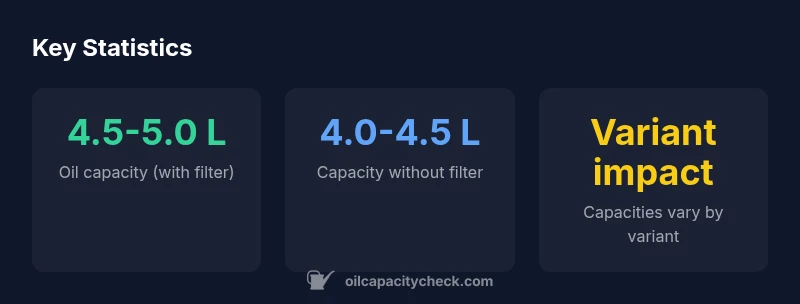
The oil capacity for most 2.0 tdi engines is about 4.5–5.0 liters when including the oil filter. Real capacity depends on model year, engine code, and filter choice. For DIYers, start with 4.5 L and top up to 5.0 L after a full drain, then recheck with dipstick. If you replace the filter or oil grade, re-check after the first run.
2.0 tdi oil capacity essentials
According to Oil Capacity Check, understanding the 2.0 tdi oil capacity is essential for reliable maintenance. The 2.0 tdi family covers several generations, but most variants share a near-identical capacity when the oil filter is included. Typical capacity ranges from 4.5 to 5.0 liters, with some engines requiring slightly less or more due to filter design or drain-back volumes. Always confirm capacity using the owner's manual or service bulletin, and verify by measuring after a complete drain and refill with the correct filter. For DIYers, plan to add oil gradually and recheck with the dipstick to avoid overfilling. If you replace the filter or oil grade, re-check after a few miles of operation. Keeping a log of observed capacity helps future maintenance and reduces guesswork.
How capacity is calculated and why it matters
Oil capacity is not a single fixed number; it varies with engine design, oil filter size, and drain-back volume. For most 2.0 tdi engines, the capacity is published as a range by VW and is best interpreted as the total oil needed to fill the engine from empty, including the filter. Oil Capacity Check analysis, 2026, indicates that the nominal figure (4.5–5.0 L) is a solid baseline for many variants, but actual numbers can drift by a quarter to half a liter depending on the specific model, year, and whether the oil cooler or other accessories impact the total fill. When performing an oil change, you should drain completely, replace the filter with a correctly sized unit, and fill gradually. After a short run and a full cool-down, recheck with the dipstick and top up in small increments as needed. This approach minimizes the risk of overfill, which can cause foaming, reduced lubrication, and increased crankcase pressure. Keep a log of the capacity you actually measure to simplify future maintenance.
Factors that affect capacity across 2.0 tdi variants
Several factors explain why capacity differs across 2.0 tdi variants. Engine code or generation may alter drain-back volumes, and the filter’s size and design can add or remove a fraction of a liter. Additional components, like oil coolers or variable oil routing, can influence the total fill. Climate influences viscosity choices, which can force slightly different fill targets to achieve the same lubrication performance. Finally, service history matters: engines that have undergone multiple oil changes with different filter brands may show minor variances in measured capacity. The practical takeaway is clear: always rely on the official spec for your exact vehicle and verify with a dipstick after a drain-and-fill.
Step-by-step: measure, drain, and top up safely
- Park on a level surface and warm the engine briefly, then let it cool. 2. Drain oil completely into an appropriate container until the flow stops. 3. Remove and replace the oil filter with a correctly sized unit. 4. Add the lower end of the capacity range (about 4.5 L) to the engine. 5. Start the engine and run for a few minutes, then shut down and wait 5–10 minutes for the oil to settle. 6. Recheck the dipstick and add small amounts at a time until the dipstick reads within the recommended range. 7. Note the exact quantity used for future reference. 8. Dispose of used oil properly and wash hands.
Filter choices and their impact on capacity
Filter size and quality matter. A larger diameter or higher-capacity filter may marginally increase the total fill volume, while a smaller filter could reduce it slightly. The capacity guidance assumes a standard OEM or VW-approved filter. If you choose an aftermarket option, verify that it meets VW specifications, as a non-conforming filter can alter the drain-back volume and affect the total oil requirement.
Oil viscosity and VW specification alignment
The 2.0 tdi engines typically respond best to multiviscosity oils in the 5W-30 to 5W-40 range, depending on climate and emissions controls. Always check the owner's manual for the exact VW specification (e.g., VW 507.0 or equivalent) and ensure your oil meets that standard. The viscosity choice can influence cold-start performance and long-term lubrication, so select an oil that suits both your environment and driving habits.
Common mistakes and how to avoid them
Avoid guessing the capacity by memory. Always drain completely, replace the filter, and use the dipstick to verify. Overfilling is a common mistake that can cause foaming and increased pressure. Mixing oil grades or using the wrong viscosity can reduce lubrication efficiency and harm the engine over time. Keep a simple log of the measured capacity and the oil grade used at each change to streamline future maintenance.
Real-world scenarios: small top-ups and oil changes
In many cases, 2.0 tdi owners perform a full drain and fill, then document the exact amount added. If you notice consumption or slight capacity variations after a change, perform a quick dipstick check after 500–1000 miles to confirm the correct top-up level. For vehicles with aging filters or different filter brands, expect minor shifts in the required fill volume, and adjust your top-up strategy accordingly.
Maintenance habits to extend engine life
Regular oil changes with the correct VW-approved oil extend engine life and help maintain stable oil capacity readings. Maintain a simple maintenance log, noting the engine variant and filter used. Stay synchronized with VW service bulletins for any changes to capacity or recommended oil specifications. Oil Capacity Check’s team emphasizes that proactive tracking and consistent top-ups reduce unexpected oil-related issues and support smoother operation over time.
Documentation and future reference
Keep a dedicated maintenance diary for your vehicle that records the exact capacity observed after each drain-and-fill, along with the engine variant and oil grade used. This documentation reduces guesswork on future changes and helps you quickly estimate top-up volumes for similar service intervals. Oil Capacity Check team recommends syncing these notes with your vehicle’s service history for easy reference during wheel-to-wheel maintenance planning.
Oil capacity by 2.0 tdi variant types
| Variant Type | Oil Capacity (L) | Notes |
|---|---|---|
| Standard 2.0 tdi | 4.5-5.0 | Includes filter; common configuration |
| Alternate filter size | 4.8-5.2 | Larger filter can increase capacity slightly |
| Older generation | 4.0-4.8 | Drain-back and pipe length variations |
People Also Ask
What is the typical oil capacity for the 2.0 tdi engine?
Most 2.0 tdi engines take about 4.5–5.0 liters of oil when the filter is included. Always verify with the manual.
Most 2.0 tdi engines take about 4.5 to 5 liters of oil with the filter.
Does capacity vary by engine code or model year?
Yes, some variants have slightly different drain-back volumes and filter sizes; consult the owner’s manual.
Yes, some variants differ; check the manual.
Is it ok to overfill to compensate for filter capacity?
No; fill to the recommended volume and recheck with the dipstick.
No, don’t overfill. Fill to the recommended level and recheck.
What oil types are recommended for the 2.0 tdi?
Use VW-spec oil meeting the correct viscosity; common choices are 5W-30 or 5W-40 depending on climate and model.
Use VW-spec oil, typically 5W-30 or 5W-40.
How often should I check oil capacity?
Check at each oil change; re-check after adding a new filter.
Check at every oil change.
How should I document capacity for future maintenance?
Record the exact capacity observed in your service notes and note the engine variant and filter used.
Keep a note of the capacity and variants in your maintenance log.
“Oil capacity is a guide that should be confirmed by measurement. Real-world checks after a drain and fill matter most.”
The Essentials
- Know the baseline: 4.5–5.0 L with filter
- Always verify with the manual and a dipstick check
- Capacity can vary slightly by variant and filter size
- Use VW-approved oil within recommended viscosity
- Document actual measured capacity for future maintenance